March 9, 2022

WGBH TV Logo


WGBH's most famous and best known logo, consisting of the company name with a double drop shadow on both sides of it, was designed by Chermayeff & Geismar. This logo's first on-air appearance occurred on March 3, 1974, during the series premiere of Nova. A network ID was produced in 1977 by Chris Pullman.

Despite being replaced by the 2020 logo, this logo is still used in tandem with said logo, and was also used for on-screen variants until October 1, 2020. 

-Fandom

February 15, 2022

Literary Pick (***)

 Stories To Tell, A Memoir
-Richard Marx


Chick Corea

 Chick Corea, Jazz Fusion Pioneer, Has Died Of Cancer At 79

The keyboardist, composer and bandleader Chick Corea — one of the most revered figures in contemporary jazz, but an artist whose work spanned fusion to classical — died on Feb. 9 at age 79.

Dan Muse from Chick Corea Productions confirmed his death to NPR on Thursday afternoon. Corea's team also reported his death on social media, saying that he died from "a rare form of cancer which was only discovered very recently." No other details about his illness and death were shared.

A pianist whose crisp touch and clarion tone were always buoyed by an effervescent way with rhythm, Corea loomed large in a jazz landscape that branched in many directions. His 1968 album Now He Sings, Now He Sobs has long been a touchstone for the modern acoustic piano trio, a format to which he often returned; in 2019 he released another album in that vein, Trilogy 2, with bassist Christian McBride and drummer Brian Blade.

As well as being named a Jazz Master by the National Endowment for the Arts in 2006, Corea has won 23 Grammys. He has been nominated a total of 67 times, including twice for Trilogy 2 this year.

He was already a talent clearly on the rise when he joined a group led by trumpeter Miles Davis in the late '60s, just as the shadowy, mercurial post-bop that had defined Davis' music of that decade was yielding to elements of funk and psychedelic rock. Playing electric piano on albums like In a Silent Way, Bitches Brew and Miles Davis at the Fillmore — often alongside his most gifted pianistic peers, Herbie Hancock, Keith Jarrett and Joe Zawinul — he helped define a new hybrid music in tune with the Aquarian Age.

His own band Return to Forever, which he formed with bassist Stanley Clarke, was an important marker for this emerging genre, known as fusion. Its first iteration drew airy inspiration from Brazilian music, before taking on a more turbocharged grandeur; the band found mainstream commercial success with a lineup featuring guitarist Al Di Meola and drummer Lenny White. (When this version of the band reunited in 2011, its itinerary included theaters and festivals more accustomed to legacy rock acts.)


Two of Corea's most popular compositions — a heraldic, syncopated anthem titled "Spain" and an ethereally grooving piece called "500 Miles High" — appear on the 1973 Return to Forever album, Light As a Feather. Among his other enduring pieces are "Matrix" and "Windows," sleek paragons of post-bop, and "La Fiesta," which captures his affinity for Spanish flamenco.

Few improvising musicians ever collaborated more broadly, or with more boundless enthusiasm. Corea did meaningful, distinctive work in duos with vibraphonist Gary Burton, vocalist Bobby McFerrin and banjoist Béla Fleck, among others; his fusion legacy extends beyond Return to Forever, including the Chick Corea Elektric Band, Chick Corea & The Vigil, and an all-star crew called the Five Peace Band (whose ranks included two other Miles Davis alumni, guitarist John McLaughlin and saxophonist Kenny Garrett). Among his many other collaborators was his wife, the singer Gayle Moran Corea.

Corea also delved into free jazz with Circle, a collective he formed in the early '70s with bassist Dave Holland, drummer Barry Altschul and saxophonist Anthony Braxton. (With Holland and Altschul, he released A.R.C., among the first albums on ECM Records.) Corea's most recent release, a solo piano double album titled Plays, includes material by Wolfgang Amadeus Mozart, Thelonious Monk, Stevie Wonder and Antonio Carlos Jobim — as well as a smattering of pieces from Corea's own 1984 album, Children's Songs. His Akoustic Band, a trio with bassist John Patitucci and drummer Dave Weckl, has a reunion album due out this May.

Prolific in every sense, Corea released well over 100 albums, and maintained a busy touring schedule. In 2018, he told Jazz Night in America about what he saw as the artist's role: "We have a mission to go out there and be an antidote to war, and all of the dark side of what happens on Planet Earth. We're the ones that go in and remind people about their creativity."

Born June 12, 1941, in Chelsea, Mass., Armando Anthony Corea grew up playing piano and drums and listening to bebop as well as classical music. His father, also named Armando, was an immigrant originally from Southern Italy, and a trumpeter who led a Dixieland band; a tune that Corea named in his honor, "Armando's Rhumba," was another staple of his repertoire.

After moving to New York as a young man, Corea played with Cuban percussionist Mongo Santamaria and other Latin jazz bandleaders like vibraphonist Cal Tjader and flutist Herbie Mann. He also worked with saxophonist Stan Getz, trumpeter Blue Mitchell and flutist Hubert Laws before making his first appearance with Davis, on the album Filles de Kilimanjaro.

At around the same time, Corea had his first encounter with Dianetics: The Modern Science of Mental Health, a book by L. Ron Hubbard that forms a cornerstone of Scientology. Corea became a prominent Scientologist, dedicating his albums to Hubbard and embracing archetypes of the religion in his album and song titles.

The social media announcement of his death included words from Corea himself: "I want to thank all of those along my journey who have helped keep the music fires burning bright. It is my hope that those who have an inkling to play, write, perform or otherwise, do so. If not for yourself then for the rest of us. It's not only that the world needs more artists, it's also just a lot of fun.

"And to my amazing musician friends who have been like family to me as long as I've known you: It has been a blessing and an honor learning from and playing with all of you. My mission has always been to bring the joy of creating anywhere I could, and to have done so with all the artists that I admire so dearly — this has been the richness of my life."


 NPR

February 14, 2022

Masterpiece Theatre Theme


Literary Pick (***)

 Surviving Intimate Terrorism
-Hedda Nussbaum 


February 3, 2022

ABC's Wide World of Sports Intro


ABC's Wide World of Sports was an American sports anthology television program that aired on the American Broadcasting Company (ABC) from April 29, 1961 to January 3, 1998, primarily on Saturday afternoons. Hosted by Jim McKay, with a succession of co-hosts beginning in 1987, the title continued to be used for general sports programs on the network until 2006. In 2007, Wide World of Sports was named by Time on its list of the 100 best television programs of all time.

Weekend sports news updates on sister radio network ABC Sports Radio, operated by Cumulus Media Networks, continue to be branded under the similar title ABC's World of Sports. The program also lent its name to an athletic facility at Walt Disney World, the ESPN Wide World of Sports Complex – which was originally known as Disney's Wide World of Sports Complex from its opening in 1997 (one year after The Walt Disney Company acquired ABC and an 80% stake in ESPN) – until 2010.

January 25, 2022

Literary Pick (****)

 Let's Take The Long Way Home: A Memoir Of Friendship
-Gail Caldwell 


January 24, 2022

Crossbay Motor Inn


Address: 13727 Cross Bay Blvd, Ozone Park, NY 11417
Phone: (718) 738-6400

Literary Pick (**)

 102 Minutes: The Untold Story of the Fight to Survive Inside the Twin Towers
-Jim Dwyer, Kevin Flynn


Louie Anderson

Louie Anderson Dies: Comedian & Emmy Winner Was 68

Louie Anderson, the veteran comedian, game show host and three-time Emmy winner, has died. He was 68.

The Baskets star died Friday morning in Las Vegas, where he had entered hospital this week for treatment of diffuse large B cell lymphoma, a form of cancer, his longtime publicist Glenn Schwartz told Deadline.


 A constant presence on stage and screen since the mid-1980s, Anderson won the 2016 Emmy for Outstanding Supporting Actor in a Comedy Series for his role as Christine Baskets, the mother of the Zach Galifianakis-portrayed Chip and Dale on the FX series. The actor was nominated in the category over three consecutive years starting in 2016 for his Baskets performance. Anderson also won two Daytime Emmys for Outstanding Performer in an Animated Program for Fox’s Life with Louie in 1997 and 1998.

According to Schwartz, Anderson, one of 11 children, was a counselor to troubled children before launching his comedy career with a first­-place trophy at the 1981 Midwest Comedy Competition. Henny Youngman, who hosted the competition, hired him as a writer.

Louie Anderson Remembered By Hollywood, Comedy World: ‘Heaven Has A Hell Of An Open Mic Night…”

Making his late-night debut on November 20, 1984, in front of Johnny Carson on The Tonight Show, Anderson had half a dozen solo stand-up specials over the years, most recently 2018’s Louie Anderson: Big Underwear

Born March 24, 1953, in Saint Paul, MN, Anderson appeared in 1988’s Eddie Murphy-led Coming to America and its 2021 sequel, among his big-screen roles. The ICM Partners-repped actor reprised his Maurice performance for two episodes of the Lena Waithe-created Twenties on BET in 2020. Playing a Gopher State psychotherapist, Anderson had short-lived sitcom The Louie Show on CBS during the 1995-96 TV season.

In 1995 Anderson debuted the Saturday morning animated series Life with Louie. The long-­running series based on Anderson’s own childhood and his life with his father won three Humanitas Prizes for writing on a children’s’ animated series, making him the only three­-time recipient of this award. The series was nominated for Outstanding Special Class Animated Program and Anderson won two Emmys for Outstanding Performer in an Animated Program.


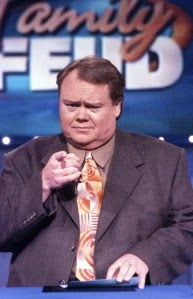
The host of Family Feud from 1999-2002 and appearing on Celebrity Family Feud in 2017, Anderson had been a regular panelist on the Jon Kelley-fronted Funny You Should Ask since the syndicated game show’s launch five years ago.

Anderson guest-starred in sitcoms including Grace Under Fire and the dramas Touched by an Angel and Chicago Hope. He had a memorable featured role in the classic 1986 film Ferris Bueller’s Day Off.

Meat Loaf Dies: ‘Bat Out Of Hell’ Singer & ‘Rocky Horror Picture Show’ Actor Was 74

In 2013 he took a dive on the ABC reality series Splash, where he conquered his own fears while becoming an inspiration of hope. His stand-up special Big Baby Boomer premiered on CMT in 2013. He also guested on Young Sheldon, was a recurring character in TBS dark comedy Search Party and had recently joined the cast of the BET series Twenties.

His best-selling books included Dear Dad – Letters from an Adult Child, a collection of poignant and humorous letters from Anderson to his late father and Good­bye Jumbo…Hello Cruel World, a self-help book for those who struggle with self-esteem issues. Anderson’s most recent book, 2018’s Hey Mom, shared insights gained from his late mother.

Anderson is survived by his two sisters, Lisa and Shanna Anderson.

 -Deadline

Literary Pick (***)

 Burning In Water, Drowning in Flame
-Charles Bukowski


January 11, 2022

Bob Saget

Bob Saget, Comic Who Starred in Sitcom ‘Full House,’ Dies at 65

The actor, who had also hosted “America’s Funniest Home Videos,” was found dead in an Orlando hotel room while on tour.

Credit...Dan Steinberg/R-STEINBERG, via Associated Press

Bob Saget, the stand-up comic and actor who was known as Danny Tanner on the long-running sitcom “Full House,” as the host of “America’s Funniest Home Videos” and for his deadpan, ribald stage routines, was found dead on Sunday in Orlando, Fla. He was 65.

His death was confirmed by the Orange County Sheriff’s Office, which said that Mr. Saget was found unresponsive in a hotel room at the Ritz-Carlton Orlando, Grande Lakes. The cause was not known, but the sheriff’s office said there were no signs of foul play or drug use.

Mr. Saget, who was on tour, had performed on Saturday night at Ponte Vedra Concert Hall in Ponte Vedra Beach, Fla., southeast of Jacksonville. In a tweet early on Sunday, he thanked the “appreciative audience.”

“I had no idea I did a 2 hr set tonight,” he said. “I’m happily addicted again to this.”

Credit...ABC Photo Archives via Getty Images
 
On “Full House,” Mr. Saget played a widowed father who shared his house with his three daughters (Candace Cameron, Jodi Sweetin and, alternating as the youngest daughter, Mary-Kate and Ashley Olsen), his brother-in-law (John Stamos) and his best friend (Dave Coulier). The show, seen on ABC from 1987 to 1995, got consistently good ratings and made stars of Mr. Saget and his fellow cast members, including Lori Loughlin, who joined in the third season.
Robert Lane Saget was born on May 17, 1956, in Philadelphia. He graduated from Temple University in 1978 before finding his way into comedy clubs. In contrast to his squeaky-clean image on “Full House” and “America’s Funniest Home Videos,” he became known for raunchy, profanity-laden stand-up routines.

At Temple, Mr. Saget studied film, and in the year of his graduation he received a student Academy Award for documentary merit for his film “Through Adam’s Eyes,” about a nephew of his who had undergone facial reconstructive surgery.

But even then he was pursuing comedy. He told The Philadelphia Inquirer in 2016 that he had won a local radio contest at 17 by singing a song about bondage, and that while he spent most of his time at Temple shooting film, he would also go to the University of Pennsylvania’s campus to do improv.

After graduating, Mr. Saget moved to Los Angeles and became a constant presence at one of the city’s main comedy clubs, the Comedy Store. “I lived in that room for seven years,” he said on the comedian Marc Maron’s podcast in 2010.

Credit...ABC Photo Archives via Getty Images
 
In 1989 also Mr. Saget became the first host of “America’s Funniest Home Videos,” a showcase for viewers’ homemade clips, many of which featured people getting hurt in unusual and farcical ways. While most of his commentary was in line with the character he played on “Full House” — funny voices and groan-inducing puns — his mordant wit sometimes slipped in.

December 31, 2021

Betty White

Betty White, ‘Golden Girls’ Star and TV Legend, Dies at 99 


Betty White, the Emmy-winning TV star who had a remarkable later-career resurgence in films, TV commercials and the hit series “The Golden Girls” and “Hot in Cleveland,” has died. She was 99.

The Los Angeles Police Department responded to a death investigation on the 500 block of N. Carmelina Ave. in Los Angeles at 9:30 a.m. Friday morning. White would have celebrated her 100th birthday on Jan. 17. White is believed to have died Thursday night at her Brentwood home.

White’s agent and close friend Jeff Witjas confirmed her death to Variety. “Even though Betty was about to be 100, I thought she would live forever,” Witjas said in a statement. “I will miss her terribly and so will the animal world that she loved so much. I don’t think Betty ever feared passing because she always wanted to be with her most beloved husband Allen Ludden. She believed she would be with him again.”

Witjas emphasized that White had not been ill but had been extremely cautious during the COVID-19 pandemic. She spent most of the past two years at the home she loved with her many pets. She had round-the-clock caretakers in her final years, Witjas said.

White’s work schedule had slowed considerably as she reached her late 90s. She told Variety in an email Q&A in 2020 that her career blossomed in the early days of TV because she was fascinated by the medium. “I just love to work and the word ‘no’ did not exist,” White told Variety. 

The approach of White’s 100th birthday sparked numerous tributes and appreciations of her long run in the industry. Just this week, White graced the cover of People magazine. “I’m so lucky to be in such good health and feel so good at this age,” White told the magazine. White was also the subject of a recent book by Variety alum Ray Richmond, “Betty White: 100 Remarkable Moments in an Extraordinary Life.”

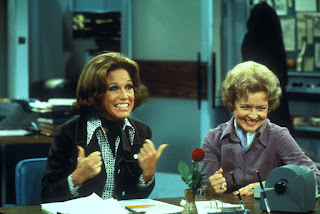
White, who played Sue-Ann Nivens on “The Mary Tyler Moore Show” in the 1970s and Rose on “The Golden Girls” from 1985-92, was a staple on TV for more than 60 years, having started as the sidekick on a local Los Angeles daytime show that kept her on live TV five hours a day, five days a week.

The energetic blonde with the honeyed voice and girl-next-door beauty was one of the rare performers to remain as popular into her nineties with new generations of viewers — thanks to reruns of “Golden Girls” — as she was in her sitcom heyday.

In her 80s, White was still stealing scenes in film comedies such as “The Proposal,” “You Again” and “Bringing Down the House,” as well as making regular appearances on late night talkshows, where she delighted audiences with her quickfire repartee with Jay Leno, Craig Ferguson and other hosts.

Her well-reviewed turn alongside Sandra Bullock and Ryan Reynolds in 2009’s “The Proposal” boosted her profile, and suddenly she was everywhere: starring in the well-received Super Bowl commercial spot for Snickers and hosting “Saturday Night Live” after a fan campaign to land her the job started on Facebook (White had actually been offered the gig years before but turned it down).

She was hired by producers of “Hot in Cleveland” for a guest shot in the pilot but was quickly pressed into service as a series regular. “Cleveland” was an instant hit thanks in no small measure to White’s star power. She earned SAG Awards for her work on the show in 2011 and 2012 and her 17th career Emmy nomination.

The hits she had in the series department were giant ones and made her a household name. Her characters on “The Mary Tyler Moore Show,” a homemaker with a rather saucy reputation, and on “Golden Girls,” a rather befuddled simpleton, were part of television history. Both programs brought her Emmys, two for “Moore” and three for “Golden Girls.”

Born in Oak Park, Ill., she moved with her family to Los Angeles, where her acting aspirations began at Beverly Hills High School. Shortly after graduation, she made her professional stage debut as part of the Bliss Hayden Little Theater, of which she was a member for several years. She also did guest stints on radio shows such as “Blondie,” “This Is Your FBI” and “The Great Gildersleeve” before branching into early television. White made her first screen appearance, however, in the 1945 educational short “Time to Kill,” promoting the benefits of the G.I. Bill.

In 1953 White landed her first sitcom, “Life With Elizabeth,” which was short-lived, as was daytime talkshow “The Betty White Show” in 1954, “A Date With the Angels” in 1957 and comedy variety skein “The Betty White Show” in 1958.

She then drifted into gameshows, including “To Tell the Truth,” “I’ve Got a Secret,” “Match Game,” “Password” and “What’s My Line?” White was also a regular on the nighttime “Jack Paar Show” and the syndicated woman’s daytime show “Girl Talk.” During that time she had her own radio show on CBS, “Ask Betty White.”

White had worked with “Password” host Alan Ludden and was appearing in summer stock with him in 1962 in “Critic’s Choice” when they became romantically involved; they married the next year. (White had been briefly married to Frederick Barker and to Lane Allen but had been single since 1949). They would co-star for years in summer stock in productions such as “Brigadoon,” “Any Wednesday” and “Guys and Dolls” as well as on TV on “Password.”

In 1971, White, an animal lover, had a talkshow called “The Pet Set,” about celebrities and their pets. (She later wrote the book “Betty White’s Pet Love.”)

White was a friend of Mary Tyler Moore when Moore’s producers were looking for a regular like Cloris Leachman. The character of Sue Ann was created with White in mind but offered to several actresses before the producers decided to go with White (who claimed, perhaps rightly, that for a time her gameshow persona was so ingrained in everyone’s mind that she was ignored for other acting jobs). The character of the Happy Homemaker, who always had sex on the brain, was an instant success and brought her back-to-back Emmys as supporting actress in 1974 and 1975.

After the Moore show ended, another series was developed for White in which she co-starred with Georgia Engel. “The Betty White Show” debuted in 1977 but was cancelled after half a season. She returned to gameshows as well as miniseries and TV movies like “The Best Place to Be,” “This Ring,” “Before and After” and “The Gossip Columnist.”

In 1983 she hosted another gameshow, “Just Men.” The show was panned but brought her another Emmy. She had a recurring role in “Mama’s Family,” a spinoff of a regular skit on “The Carol Burnett Show” in which Rue McClanahan also recurred.

Though she was originally slated for the role of the promiscuous southern Belle on “The Golden Girls,” she chose instead to play Rose, the slightly akilter but sweet-hearted character in the series targeted at an older demo (McClanahan got the Belle role). It was a huge hit running into the early ’90s and added two more Emmys to White’s shelf. She carried on for another season in the spinoff “The Golden Palace” and then segued into a regular role on Newhart series “Bob” and 1995’s “Maybe This Time.”

Television movies and regular guest appearances on shows as diverse as “St. Elsewhere” and “Suddenly Susan” kept White constantly in front of the camera, as did the occasional TV movie like “Weekend in the Country.”

In 1999 an appearance in David E. Kelley’s monster crocodile movie “Lake Placid” renewed attention on White: She lampooned her love of animals by playing a smiling but foul-mouthed woman who protects the predator that’s dispatching humans.

She was a television phenomenon in the 2000s, guesting as herself on “Ugly Betty” as well as in animated form on both “The Simpsons” and “Family Guy” and providing voices for many animated films and TV shows.

White recurred on soap “The Bold and the Beautiful” from 2006-09, on “That ’70s Show” and as Catherine Piper both on “The Practice” and on “Boston Legal.” In 2010 she became the oldest person ever to host “Saturday Night Live.”

In January 2012 the NBC special “Betty White’s 90th Birthday: A Tribute to America’s Golden Girl’’ was the most-watched program on the night. White hosted and produced the hidden-camera reality show “Off Their Rockers” in 2012-13, earning two more Emmy nominations.

Her most recent book, “If You Ask Me (And of Course You Won’t),” was published in 2011. She won a Screen Actors Guild life achievement award in 2010.

Ludden died in 1981, and White never remarried.

(Carmel Dagan contributed to this report.)

 -Variety

December 14, 2021

Literary Pick (****)

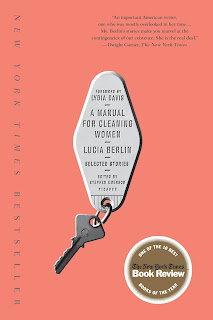
 A Manual for Cleaning Women: Selected Stories
-Lucia Berlin


Dean Stockwell


Veteran actor Dean Stockwell, best known for playing Admiral ‘Al’ Calavicci opposite Scott Bakula’s Dr. Sam Beckett in NBC’s sci-fi dramedy Quantum Leap, died Sunday of natural causes. He was 85. 

Airing from March 1989 to May 1993, Quantum Leap starred Bakula as Dr. Sam Beckett, a physicist who in testing out a time travel theory “leapt” into the body of an Air Force pilot 50 years in the past. In trying to return home, Sam realized he could only randomly leap into other people, in other times. Stockwell played Sam’s womanizing, cigar-smoking hologram of a BFF/companion.

The role of Admiral ‘Al’ Calavicci earned Stockwell four Emmy Award nominations for Supporting Actor in a Drama Series, as well as one Golden Globe award.

He later recurred as Brother Cavil in Syfy’s reboot of Battlestar Galactica (2004–2009). Additional TV credits included JAG and 1998’s short-lived Tony Danza Show.

Born in North Hollywood in 1936, Stockwell was on Broadway by the time he was age 7, and his career as a child star began. As a child actor of the 1940s, his credits included the films Song of the Thin Man, The Boy with Green Hair, Kim and Gentleman’s Agreement (for which he won a Golden Globe).

His later big-screen credits included David Lynch’s Dune (1984) and Blue Velvet (1986), as well as To Live and Die in L.A. (1985), Beverly Hills Cop II (1987), The Player (1992) and Air Force One (1997). Stockwell scored an Oscar nomination for his supporting performance in the 1988 comedy Married to the Mob.

Stockwell is survived by his wife, Joy, and their two children, Austin and Sophie.

-TVLine


October 31, 2021

Literary Pick (***)

 Old Yeller
by Fred Gipson


October 4, 2021

Milford Plaza Commercial


September 28, 2021

Ed Asner, Renowned Character Actor, Dies at 91

Ed Asner, Renowned Character Actor, Dies at 91  

 Asner’s career extended far beyond Lou Grant.


Actress Shirley MacLaine and Ed Asner at the 1981 Emmy Awards.by Ron Galella/WireImage.
 

“The world for me is divided into three spaces,” Ed Asner told AM New York in 2016. Those spaces: “Lou Grant, Up, and Elf.” While those are his most identifiable credits, they only hint at the breadth and depth of this consummate character actor and controversial activist, who died on Sunday at the age of 91

In the days to come, expect to see this Asner clip a lot. You should know which one without even clicking on it. His impeccably-timed delivery of one of the most quoted lines in television history—“I hate spunk,” barked at job applicant Mary Richards in the pilot episode of The Mary Tyler Moore Show—instantly and indelibly defined newsman Lou Grant, the character Asner embodied and made iconic for seven seasons on that show, and then for another five on the spin-off series, Lou Grant.

Asner knew he had nailed the “spunk” scene. “I felt such power at that moment,” he told V.F. in 2017. “I could command those 300 people [in the audience] to march into the sea if it was nearby.”

The Mary Tyler Moore Show made Asner an “overnight” star after more than a decade of steady appearances in television and films. As Lou Grant, Asner became the first actor to win comedy and drama Emmy Awards for playing the same character. He won seven Emmy Awards (out of 10 nominations) and five Golden Globes (out of six nominations).

But he did not rest on those estimable laurels. Over the course of his 60-year career, Asner’s stocky build, gruff voice, and glowering visage made him a good fit for characters on both sides of the law—the villain or the cop, or even the network executive. But his inner-softy’s smile and twinkling eyes made him ideal to portray grumpy but lovable old men (Up) and Santa Claus—which, according to the Internet Movie Database, he did nine times, most notably opposite Will Ferrell in the feature film Elf.

In his 80s, Asner embarked on new acting challenges, including FDR, a one-man show in which he portrayed the 32nd president. “I love the work of acting,” he said in a 2009 interview with a suburban Chicago newspaper chain. “It’s the only thing I’m good at. One of the reasons I took [the role] is I’ve never done a one-man show, and I relish the challenge.” In 2012, at the age of 82, he returned to Broadway after an absence of 23 years in Grace opposite Paul Rudd and Michael Shannon.

In March 2013, while on tour with FDR, he was taken off the stage at the Marquette Park Pavilion in Gary, Indiana, and hospitalized for exhaustion. But that did not slow him down for long. About 60 of Asner’s more than 360 IMDB credits date from 2014 to the present. In 2017, he co-starred in the ensemble independent film The Parting Glass and toured with another one-man show, A Man and His Prostate, written by Emmy and Peabody Award-winner Ed Weinberger. Weinberger also wrote or co-wrote some of the most memorable episodes of The Mary Tyler Moore Show, including the series finale.

Asner was born into an Orthodox Jewish family on November 15, 1929, in Kansas City, Missouri, but he grew up in Kansas City, Kansas. He worked as an announcer for his high-school radio station. While attending the University of Chicago, he appeared in a production of Richard III on a closed-circuit dormitory radio station started by his two roommates.

After serving in the army, he returned to the university, where he was recruited to join the Playwrights Theatre Club alongside such future luminaries as Mike Nichols, Elaine May, Barbara Harris, and Sheldon Patinkin. (The ensemble would evolve into an improvisational ensemble called the Compass Players, and then Second City.)

Asner departed for New York in 1955 (“you had to if you wanted respect as an actor,” he told the New York Times in a 1973 interview). For almost three years, he co-starred in the Off-Broadway production of The Threepenny Opera while also doing television work. He performed in several Shakespeare productions, and in 1960 was cast in a small role opposite Jack Lemmon in the play Face of a Hero, which ran for only 36 performances. 

The next year, Asner and his first wife, Nancy Sykes, whom he married in 1959 (they divorced in 1988), relocated to Los Angeles, where he worked steadily on TV series as varied as Route 66, The Alfred Hitchcock Hour, and The Outer Limits before landing his first series in 1964, Slattery’s People, in which he co-starred with Richard Crenna. It lasted two seasons.

In the years leading up to getting cast on The Mary Tyler Moore Show, Asner appeared in iconic and cult series that included The Fugitive, Rat Patrol, Gunsmoke, The Invaders, and Mission: Impossible. “When I came out to Hollywood in 1961, I was determined not to be typecast,” Asner told The Spectrum in 2016. “My agent and I worked assiduously ever since to make sure that never happened.”

A rare foray into comedy as a police chief in the 1971 made-for-TV movie They Call It Murder made an impression on network executive Grant Tinker, who was then married to Mary Tyler Moore. When it came time to cast The Mary Tyler Moore Show, he recommended that Asner be brought in to audition for the role of Lou Grant. In an interview for the Archive of American Television, Asner credited CBS casting executive Ellen Weinert with assuring Tinker that he could handle a sitcom. As Asner recalled, she told Tinker, “Ed Asner can do anything.”

“Anything” included two benchmark made-for-TV miniseries, Rich Man, Poor Man, and Roots, which aired while The Mary Tyler Moore Show was on the air. Asner’s featured roles as an embittered German immigrant father and slave ship captain, respectively, earned him Emmy Awards.

The spin-off series Lou Grant premiered in 1977, but despite garnering critical acclaim and racking up a dozen Emmys as well as Peabody and Humanitas Awards, it was unceremoniously canceled in 1982.

Asner, a liberal and self-described “staunch unionist,” did not think it was a coincidence that the show’s demise coincided with his contentious two-term tenure as president of the Screen Actors Guild—and, specifically, a 1982 press conference at which he proclaimed his support for victims of El Salvador’s civil war and announced his humanitarian donation of $25,000 for medical supplies. Critics contended Asner did not make it clear he was acting as a private citizen and not as president of the union. Asner served from 1981 to 1985.

The ever-defiant Asner did not mellow with age. He was an outspoken critic of the war in Iraq, and in 2013 expressed equal opposition to any proposed military action in Syria. In January 2017, he joined a roster of celebrities in signing a petition of anti-fascist resistance against then-president-elect Donald Trump.

“Whether it’s a Republican or Democrat president, or Republican or Democrat Congress—and it doesn't make a God-damned difference—it behooves us to get off our ass and ask questions," Asner told the Hollywood Reporter in 2013. 

With the possible exception of the SAG incident, his outspoken views did not seem to hinder his career. He graced such celebrated series as ER, The X-Files, The Practice, and The Good Wife, while he lent his distinctive voice to such animated series as The Simpsons, King of the Hill, Family Guy, The Boondocks, and Spider-Man. In 2001, the Screen Actors Guild honored him with its Lifetime Achievement Award.

Asner’s career soared to new heights with Pixar’s 2009 computer-animated film Up, which earned an Academy Award for Best Animated Feature. Asner voiced Carl, a stay-at-home widower who, facing eviction, ties thousands of balloons to his house and embarks on a South American adventure.

Beyond Elf and Up, perhaps Asner’s most notable feature film roles were opposite John Wayne in the 1966 Howard Hawks western El Dorado, Paul Newman in Fort Apache, the Bronx in 1981, and in two movies starring Elvis Presley, Kid Galahad in 1962 and Change of Habit in 1969. Presley’s leading lady in that film was Asner’s future co-star Mary Tyler Moore, but the two did not share any scenes together.

In 2016, at the age of 85, Asner filed for divorce from his second wife, Cindy Gilmore, whom he married in 1998. The couple had been separated for eight years.

Asner will be remembered for much more than Lou Grant, Up, and Elf. He was the very model of a working actor. “Where the work goes, I go,” he joked in a 2012 USA Today interview. “Wherever adulation occurs, that’s where you’ll find me.”

August 9, 2021

Johnny Ventura

Dominican Merengue Star Johnny Ventura Dies At 81


The popular Dominican merengue musician Johnny Ventura has died. According to Dominican news media, the 81-year-old musician died after a sudden heart attack in his home country on Wednesday. The news was later confirmed by Ventura's son on social media.

Ventura started life as Juan de Dios Ventura Soriano, and became well-known as El Caballo Mayor, as both his husky voice and the very danceable, Afro-Caribbean style of his chosen music became popular across Latin America.

Starting in the 1960s, Ventura had a string of hits that became classics ("Patacon Pisao," "Pitaste," "Merenguero Hasta La Tumbadora") and also transformed merengue from a folk music to an international sensation. He further modernized the music by adding complex horn arrangements and even elements of rock and roll, which became a useful canvas for Ventura's elaborate stage choreography and musical arrangements.

Just before his death, Ventura had posted about how much he was looking forward to performing in front of his fans after the long pandemic lockdown.


Ventura's career coincided with a renewed interest in Afro-Caribbean music, thanks in no small part to New York-based record label Fania Records, which revived interest in work from Cuba, Puerto Rico and the Dominican Republic in the late '60s and throughout the '70s. The merenguero earned the respect and admiration of salsa stars like Celia Cruz, who recorded several songs featuring the hip-swinging style. Ventura also ventured into politics, serving first as vice mayor of the Dominican Republic's capital city of Santo Domingo from 1994 to 1998, then as mayor from 1998 to 2002.

The grand dame of Cuban song, Omara Portuondo, paid tribute to Ventura on Twitter from her home in Havana: "Artista inmenso, corazón radiante y alegre 'hasta la tumbadora. Gracias, nunca te olvidaremos."

-NPR

July 2, 2021

Branded Theme


 Branded is an American Western series that aired on NBC from 1965 through 1966. It was sponsored by Procter & Gamble in its Sunday night, 8:30 p.m. Eastern time period. The series is set in the post Civil War old west. The show starred Chuck Connors as Jason McCord, a United States Army cavalry captain who had been court-martialed and drummed out of the service following an unjust accusation of cowardice

-wikipedia

June 24, 2021

Irene Suchocki

 Taxi Cab Confessions


May 30, 2021

Literary Pick (****)

 Sofia: Living and Loving: Her Own Story
-by A.E. Hotchner 


May 29, 2021

Crossbay Movie Theatre

UA Crossbay 
9411 Rockaway Boulevard, Ozone Park, NY 11417
 

The 1,425-seat Cross Bay Theatre opened in December 1924. Located on the corner of Rockaway and Woodhaven Boulevards, the theatre was later known as the Crossbay. It was a Randforce house and then was operated by United Artists. In the 1970s the auditorium was twinned, and in the early 1980s a third auditorium was built in space once occupied by retail stores.

The UA Crossbay closed on June 23, 2005, and the building was converted to retail. 

-Cinema Treasures