September 26, 2013

Quote of the Day

“Tame the savageness of man and make gentle the life of this world.”
Aeschylus

September 10, 2013

Literary Pick (****)

Kaddish for Saddam Hussein
Stories by Fawzy Zablah

This is the second collection of work I've read by this author, and I want to first state that out of all the short stories books I've ever read, and there have been plenty, I can vouch that every single story in this collection is spectacularly independent of one another. Typically, in my opinion, when you read short stories they all somehow seem redundant and laborious after the first 3 or so, but not with this collection... each story is oddly, yet refreshingly gripping. Some are funny, others sad, and even shocking. What i like the most about them all is how unpredictable they are. They are all stories that have not been told in any way before.

-The first story "Kaddish for Saddam Hussein" is about a man by the name of Hassan Al-Hazeem, who is a rapist for hire under the dictator Saddam Hussein in Iraq. He was promoted to the Super Secret Rape Squad after being caught with the mistress of an army captain. He's sent out to rape all kind of victims. Some of the victims unappealing and over-weight. In the process he meets a woman by the name of Ludmilla, who is also a hired rapist for the SSRS. She's hired to sodomize men. Hassan ends up falling in love with Ludmilla, and they begin clandestine affair.
One of the reasons I particularly enjoyed this story is because despite it's dark theme, it was actually quite light-hearted and even a bit funny. Hassan's character was energetic and endearing. He reminded me so much of Rinaldi from Hemingway's "Farewell to Arms".


Oslo
-This story is about Habib Al-Fulan who seems to have terrifying recurring dreams of Miami being invaded by bombs falling from the sky. After one of these nightmares he has made up his mind to move to Oslo, where his friend John Voorten lives, whom he met while on a trip to NYC. His friend John has offered him a place to stay and even offers him a job at his fathers gallery. There's so much more to the story, but I won't go into all that because what I'd like to discuss about it is something that resonated with me, and that was his life-living goal of getting to Oslo, a place he's never visited before. For some reason I was able to relate to that throughout the entire story. When you get this idea in your head about a place you've never been to before, in a culture you've never experienced, yet you somehow believe and are certain you can start a whole new life there and everything will be perfect, your dream life begins. Can't tell you how disappointed I've been by such expectations. I felt like that about Paris once, until I visited. Although, I could still see myself living there now that the initial culture shock has worn off, but it's funny how we put certain places on a pedestal and they are just as good or bad as any place else. I also for a while felt like that about Spain, which I have not visited yet, but will this coming December. I don't know why but for a while (not anymore) I thought i could solve the worlds problems if I could just move to Spain. It's just stupid crazy shit. Why people get fixated on locations beats me, but that's what this story signified for me.

This Modern Man is Beat
-My absolute favorite of all the stories. In this one Habib bin Habib al Fulan reappears again, but this time down and out. What blew me away about this particular story is how well the author was able to paint a clear picture of the environment and surroundings, the whole scene around the His N' Hers" motel. I could just picture exactly what the motel looked like, I envision the one in Breaking Bad where Jessie meets with that old lady crack-whore. Picturing him walking block after block with his guitar in hand, desperately trying to get the best deal on it possible. It reminds me of something in my childhood, but i don't know what exactly...but the end is surprisingly pitiful and depressing. I enjoy endings like that very much. It makes a story worth while for me.

Leaving for Paris
-Pyotr Rublyov is half Cuban, half Russian guy that goes by the nickname Doofy.
The story begins with him making a call to a prostitute by the name of Virginia, whom he goes to meet at the wrong Lindon motel address, there are two, but then later meets up with her in the correct one.
Two weeks later he goes on a second date, this time with a regular girl by the name of Klarissa, who sort of dumps him at a party to be with this other dude. Klarissa and Doofy still leave together though, but they never stay in touch after that.
Doofy then gets into a discussion with his friend Gabriel who tells him he's "doofy", that his whife says he's doofy, a combination of duffud and goofy, and Doofy is like wtf?

Later he falls alssep, dreams of this girl in Paris, wakes up to the sound of coughing, and it's his mom who is short of breath, so he rushes her to the hospital, and the story ends.

This was a simple story, but like with all Zablah's works it's all in the craft of writing and
being able to master proper character interactions. His stories are honest, unpretentious, and at times sobering.


Marchesa-
This story is about conjoined twins, Fawzi and Habib, who both get beaten rather severely in a night club of dancers, and wind up hospitalized with a parade of exotic visitors, including a dancer by the name of Marchessa, whom they decide they want to ask out on a date to watch a movie, of which they can't agree on. They invite their old professor from community college whose name is Merkel, to help decide which genre type film to take her to. Habib wants to just get in her pants, Fawzy is looking for a deeper more meaningful relationship...
How does the author come up with stories like this? they are wholey bizarre, but they work!
The Dialogue that goes on between Fawzi and Habib in the presence of the professor is  brilliantly entertaining. I actually read this story twice.


La Femme-
In this one Habib once again reappears, this time as a jilted husband whose wife leaves him for another man. They both have a daughter together by the name of Tessa. He seems to have subconscious fantasies about her death because he often comes across images of her dead corpse as he's out and about with his daughter. His neighbor Miguel Torres is also having marital issues...they talk a bit about it out in the front.
This is another story that has a lot of intrigue and provokes many interesting thoughts. I read this one twice as well.


A Brief History of my Parents Union
-This was my second favorite story because a lot of it hit close to home for me. It brought me back to the time I remember my grandma still being somewhat young. The tumultuous relationship of my own mother and father. I love stories like this because even though they are kind of sad and unfortunate, they are also nostalgic and leave you feeling melancholy. I think that's exactly why I love all this authors stories, they bring me back to a time before it became the end of an era.

The two of us in a raft in the middle of the universe
-This one rocked my socks off. I feel like I can't even write a word about it without giving it away, but it's about these two guys, one whose name is Montes, and they sit in diners listening to people's conversations. That's all i can say about it, but trust me it gets good. This premise would be a good movie. Guys that go into places like that just to hear people's conversations for that purpose.

The United States of America Circa 2003
-One Paragraph but funny.


Liberty City
-This one is about a young boy (13 years old) whose name I'm not 100% certain is mentioned but is often referred to as "primo" which means "cousin" in Spanish. He hangs out with his older cousin Phillip who is a Vietnam veteran drug addict hoodlum (age 28). "Primito" idolizes Phillip, because he wants to be a badass too. He accompanies Phillip in a lot of his shenanigans, like when Phillip went to beat a guy up at a bar, then letting primo hold guns and do drugs.  Phillip is obviously a very violent person, and enjoys killing innocent animals too, is obviously twisted and disturbed, and very intimidating. I felt afraid for primito throughout the entire story, especially when he told primo he was going to take him target practicing, like wtf, where is his mother. Anyway, every time Phillip causes violence or death two soldiers seem to appear out of no where, and only primito sees them. He recognizes them from old war pictures Phillip showed him when they fought in Vietnam, except that Phillip claims they are dead. i don't know what it's suppose to symbolized but I liked it. It adds a creepiness to it.


All in all these were a great collection of short stories, and I had a lot of fun reading them. Looking forward to the authors new book coming out in this fall 2013 called Rarity of the Century.

August 28, 2013

Speech

Fifty years ago Wednesday, from the steps of the Lincoln Memorial in Washington, DC, Martin Luther King Jr. delivered one of the most memorable speeches in American history. The following is the full text of the speech, as transcribed on The Huffington Post.


I am happy to join with you today in what will go down in history as the greatest demonstration for freedom in the history of our nation.
Five score years ago, a great American, in whose symbolic shadow we stand today, signed the Emancipation Proclamation. This momentous decree came as a great beacon light of hope to millions of Negro slaves who had been seared in the flames of withering injustice. It came as a joyous daybreak to end the long night of their captivity.
But one hundred years later, the Negro still is not free. One hundred years later, the life of the Negro is still sadly crippled by the manacles of segregation and the chains of discrimination. One hundred years later, the Negro lives on a lonely island of poverty in the midst of a vast ocean of material prosperity. One hundred years later, the Negro is still languishing in the corners of American society and finds himself an exile in his own land. So we have come here today to dramatize a shameful condition.
In a sense we have come to our nation's capital to cash a check. When the architects of our republic wrote the magnificent words of the Constitution and the Declaration of Independence, they were signing a promissory note to which every American was to fall heir. This note was a promise that all men, yes, black men as well as white men, would be guaranteed the unalienable rights of life, liberty, and the pursuit of happiness.
It is obvious today that America has defaulted on this promissory note insofar as her citizens of color are concerned. Instead of honoring this sacred obligation, America has given the Negro people a bad check, a check which has come back marked "insufficient funds." But we refuse to believe that the bank of justice is bankrupt. We refuse to believe that there are insufficient funds in the great vaults of opportunity of this nation. So we have come to cash this check -- a check that will give us upon demand the riches of freedom and the security of justice. We have also come to this hallowed spot to remind America of the fierce urgency of now. This is no time to engage in the luxury of cooling off or to take the tranquilizing drug of gradualism. Now is the time to make real the promises of democracy. Now is the time to rise from the dark and desolate valley of segregation to the sunlit path of racial justice. Now is the time to lift our nation from the quick sands of racial injustice to the solid rock of brotherhood. Now is the time to make justice a reality for all of God's children.
It would be fatal for the nation to overlook the urgency of the moment. This sweltering summer of the Negro's legitimate discontent will not pass until there is an invigorating autumn of freedom and equality. Nineteen sixty-three is not an end, but a beginning. Those who hope that the Negro needed to blow off steam and will now be content will have a rude awakening if the nation returns to business as usual. There will be neither rest nor tranquility in America until the Negro is granted his citizenship rights. The whirlwinds of revolt will continue to shake the foundations of our nation until the bright day of justice emerges.
But there is something that I must say to my people who stand on the warm threshold which leads into the palace of justice. In the process of gaining our rightful place we must not be guilty of wrongful deeds. Let us not seek to satisfy our thirst for freedom by drinking from the cup of bitterness and hatred.
We must forever conduct our struggle on the high plane of dignity and discipline. We must not allow our creative protest to degenerate into physical violence. Again and again we must rise to the majestic heights of meeting physical force with soul force. The marvelous new militancy which has engulfed the Negro community must not lead us to a distrust of all white people, for many of our white brothers, as evidenced by their presence here today, have come to realize that their destiny is tied up with our destiny. They have come to realize that their freedom is inextricably bound to our freedom. We cannot walk alone.
As we walk, we must make the pledge that we shall always march ahead. We cannot turn back. There are those who are asking the devotees of civil rights, "When will you be satisfied?" We can never be satisfied as long as the Negro is the victim of the unspeakable horrors of police brutality. We can never be satisfied, as long as our bodies, heavy with the fatigue of travel, cannot gain lodging in the motels of the highways and the hotels of the cities. We cannot be satisfied as long as the Negro's basic mobility is from a smaller ghetto to a larger one. We can never be satisfied as long as our children are stripped of their selfhood and robbed of their dignity by signs stating "For Whites Only". We cannot be satisfied as long as a Negro in Mississippi cannot vote and a Negro in New York believes he has nothing for which to vote. No, no, we are not satisfied, and we will not be satisfied until justice rolls down like waters and righteousness like a mighty stream.
I am not unmindful that some of you have come here out of great trials and tribulations. Some of you have come fresh from narrow jail cells. Some of you have come from areas where your quest for freedom left you battered by the storms of persecution and staggered by the winds of police brutality. You have been the veterans of creative suffering. Continue to work with the faith that unearned suffering is redemptive.
Go back to Mississippi, go back to Alabama, go back to South Carolina, go back to Georgia, go back to Louisiana, go back to the slums and ghettos of our northern cities, knowing that somehow this situation can and will be changed. Let us not wallow in the valley of despair.
I say to you today, my friends, so even though we face the difficulties of today and tomorrow, I still have a dream. It is a dream deeply rooted in the American dream.
I have a dream that one day this nation will rise up and live out the true meaning of its creed: "We hold these truths to be self-evident: that all men are created equal."
I have a dream that one day on the red hills of Georgia the sons of former slaves and the sons of former slave owners will be able to sit down together at the table of brotherhood.
I have a dream that one day even the state of Mississippi, a state sweltering with the heat of injustice, sweltering with the heat of oppression, will be transformed into an oasis of freedom and justice.
I have a dream that my four little children will one day live in a nation where they will not be judged by the color of their skin but by the content of their character.
I have a dream today.
I have a dream that one day, down in Alabama, with its vicious racists, with its governor having his lips dripping with the words of interposition and nullification; one day right there in Alabama, little black boys and black girls will be able to join hands with little white boys and white girls as sisters and brothers.
I have a dream today.
I have a dream that one day every valley shall be exalted, every hill and mountain shall be made low, the rough places will be made plain, and the crooked places will be made straight, and the glory of the Lord shall be revealed, and all flesh shall see it together.
This is our hope. This is the faith that I go back to the South with. With this faith we will be able to hew out of the mountain of despair a stone of hope. With this faith we will be able to transform the jangling discords of our nation into a beautiful symphony of brotherhood. With this faith we will be able to work together, to pray together, to struggle together, to go to jail together, to stand up for freedom together, knowing that we will be free one day.
This will be the day when all of God's children will be able to sing with a new meaning, "My country, 'tis of thee, sweet land of liberty, of thee I sing. Land where my fathers died, land of the pilgrim's pride, from every mountainside, let freedom ring."
And if America is to be a great nation this must become true. So let freedom ring from the prodigious hilltops of New Hampshire. Let freedom ring from the mighty mountains of New York. Let freedom ring from the heightening Alleghenies of Pennsylvania!
Let freedom ring from the snowcapped Rockies of Colorado!
Let freedom ring from the curvaceous slopes of California!
But not only that; let freedom ring from Stone Mountain of Georgia!
Let freedom ring from Lookout Mountain of Tennessee!
Let freedom ring from every hill and molehill of Mississippi. From every mountainside, let freedom ring.
And when this happens, when we allow freedom to ring, when we let it ring from every village and every hamlet, from every state and every city, we will be able to speed up that day when all of God's children, black men and white men, Jews and Gentiles, Protestants and Catholics, will be able to join hands and sing in the words of the old Negro spiritual, "Free at last! free at last! thank God Almighty, we are free at last!"

August 27, 2013

Literary Pick (***)

The War of the Roses- The Children
-Warren Adler

August 18, 2013

Literary Pick (*)

Ida
-Gertrude Stein

August 15, 2013

Literary Pick (****)

Life, On the Line
-Grant Achatz and Nick Kokonas

August 14, 2013

Film Quote

"Of all the gin joints, in all the towns, in all the world, she walks into mine."
- Rick Blaine (Humphrey Bogart) in Casablanca

August 8, 2013

Honor Spotlight

Pedro Zamora
Cuban-American AIDS educator
Born: February 29, 1972, Diezmero, Cuba
Died: November 11, 1994, Coconut Grove, Miami, FL


Pedro Zamora (February 29, 1972 – November 11, 1994) was a young openly-gay HIV-positive AIDS educator when he was cast as a housemates on the groundbreaking MTV reality show Real World San Francisco. For many young Americans, watching Zamora on camera was their first exposure to a young person living with AIDS. His appearance on the popular show has been credited with increasing AIDS awareness and normalizing those with the disease.

About Pedro Zamora:

Pedro Zamora was born in Havan, Cuba on the leap day of a leap year (February 29, 1972). According to a Wikipedia report, a Santeria priestess deemed Zamora a grande cabeza or "wise one" born to save lives. Zamora came to the U.S. as a Cuban immigrant at the age of 8.

Pedro Zamora and HIV:

Zamora found out he was HIV-positive after giving blood during his junior year of high school. He turned to the Miami-based HIV/AIDS resource center Body Positive for help and support before speaking about his own experience living with the virus. Zamora entered the national spotlight as an AIDS advocate after being featured by Eric Morganthaler on a front page article of the Wall Street Journal. Interviews by Geraldo Rivera, Phil Donahue and Oprah Winfrey followed.
On July 12, 1993, he testified before the United States Congress concerning HIV/AIDS awareness and educational programs. Zamora argued, "If you want to reach me as a young gay man -- especially a young gay man of color -- then you need to give me information in a language and vocabulary I can understand and relate to." Much of Zamora's message still rings true today as gay people of color continue to suffer from rising HIV rates.

More on Pedro Zamora and The Real World:

Pedro Zamora was chosen as a castmember of the MTV reality show, The Real World San Francisco in 1994. He took his new role as an opportunity to teach HIV/AIDS awareness. Zamora educated all of America at the same time he eased the anxieties of his Real World housemates. Zamora began dating partner Sean Sasser while on the show. They exchanged vows in the Real World loft. The show aired a week after the cast moved out of the loft.

Pedro's Last Days:

Pedro's health began to deteriorate during the taping of the show. However, things only got worse after they moved he moved out. Zamora’s T-cell count had dropped to an alarming 32 and he suffered from PML and other serious illnesses. Pedro Zamora died at approximately 4:40am EST on November 11, 1994, the day after the final episode of The Real World San Francisco aired.

Pedro Zamora's Legacy:

Zamora was honored by former President Bill Clinton for his HIV/AIDS awareness work. SW 59th Street in Miami, Florida was given the name "Pedro Zamora Way."


Old News

Earlier this morning, ARTINFO reported that famed choreographer Yvonne Rainer sent a letter to Los Angeles MOCA director Jeffrey Deitch denouncing artist Marina Abramovic’s plans for the museum’s annual gala, which involves installing performers under gala tables, turning them into disembodied rotating heads for three-hour-long stretches over a period of two days. The performers would be paid a paltry $150 for their troubles. Read the full text of the letter below.
November 9, 2011
To Jeffrey Deitch:
I am writing to protest the “entertainment” about to be provided by Marina Abramovic at the upcoming donor gala at the Museum of Contemporary Art. It has come to my attention that a number of young people will be ensconced under the diners’ tables on lazy Susans and also be required to display their nude bodies under fake skeletons.
This description is reminiscent of “Salo,” Pasolini’s controversial film of 1975 that dealt with sadism and sexual abuse of a group of adolescents at the hands of a bunch of post-war fascists. Reluctant as I am to dignify Abramovic by mentioning Pasolini in the same breath, the latter at least had a socially credible justification in the cause of anti-fascism. Abramovic and MOCA have no such credibility, only a flimsy personal rationale about eye contact. Subjecting her performers to public humiliation at the hands of a bunch of frolicking donors is yet another example of the Museum’s callousness and greed and Ms Abramovic’s obliviousness to differences in context and to some of the implications of transposing her own powerful performances to the bodies of others. An exhibition is one thing — this is not a critique of Abramovic’s work in general — but titillation for wealthy diners as a means of raising money is another.
Ms Abramovic is so wedded to her original vision that she – and by extension, the Museum director and curators — doesn’t see the egregious associations for the performers, who, though willing, will be exploited nonetheless. Their desperate voluntarism says something about the generally exploitative conditions of the art world such that people are willing to become victims of a celebrity artist in the hopes of somehow breaking into the show biz themselves. And at sub-minimal wages for the performers, the event verges on economic exploitation and criminality.
This grotesque spectacle promises to be truly embarrassing. We the undersigned wish to express our dismay that an institution that we have supported can stoop to such degrading methods of fund raising. Can other institutions be far behind? Must we re-name MOCA “MODFR” or the Museum of Degenerate Fund Raising?
Sincerely,
Yvonne Rainer
 BlouinArtInfo

August 7, 2013

Art of the Day

Earth’s Skin


El Anatsui (Ghanaian, b. 1944)
2007, Aluminum and copper wire, 177 x 394 in. (449.6 x 1000.8 cm). Courtesy of Guggenheim Abu Dhabi

NYT

August 5, 2013

Literary Pick (***)

Simple Passion
-Annie Ernaux

August 3, 2013

Literary Pick (****)

Ciao! Miami 
-Fawzy Zablah


July 31, 2013

Literary Pick (***)

Middlesex
-by Jeffrey Eugenides

July 30, 2013

RIP

Eileen Brennan, Who Played Flinty Captain in ‘Private Benjamin,’ Dies at 80


Eileen Brennan, a smoky-voiced actress who had worked in show business for more than 20 years before gaining her widest attention as a gleefully tough Army captain in both the film and television versions of “Private Benjamin,” died on Sunday at her home in Burbank, Calif. She was 80. 

Her manager, Kim Vasilakis, confirmed the death on Tuesday, saying the cause was bladder cancer.
Ms. Brennan had had a solid career on the New York stage and in films like “The Last Picture Show” and “The Sting” when she was cast for the film “Private Benjamin,” a 1980 box-office hit starring Goldie Hawn in the title role.
Ms. Brennan played Capt. Doreen Lewis, the slow-burning commanding officer of a pampered, privileged young woman who joins the Army and finds that she isn’t anybody’s little princess anymore. The performance brought Ms. Brennan an Academy Award nomination for best supporting actress. She reprised the role in 1981 in a CBS sitcom based on the film, with Lorna Patterson in the Goldie Hawn role. The TV performance brought Ms. Brennan the Emmy Award for best supporting actress in a comedy, variety or music series. She was nominated for a total of seven Emmys in her career.
But she was forced to leave “Private Benjamin” the following October, when she was hit by a car and critically injured in Venice, Calif. Without her, the series died.
While recovering Ms. Brennan became addicted to pain medication and underwent treatment and later developed breast cancer.
She returned to television in 1985 in a new sitcom, “Off the Rack,” with Edward Asner, but the show lasted only six weeks. Afterward she made guest appearances on other shows. But she never recaptured the attention she had known in the past — as the toast of Off Broadway in “Little Mary Sunshine,” as a film actress in the 1970s, and as an honored comedy star just before her accident.
Verla Eileen Regina Brennan was born on Sept. 3, 1932, and grew up in Los Angeles, the daughter of a newspaper reporter who also worked in sales and a former actress. Later in life, dealing with her own alcohol dependency, she talked about the alcoholism in her family when she was a child.
After attending Georgetown University in Washington, she studied acting at the American Academy of Dramatic Arts in New York, did summer stock and worked as a singing waitress.
Her first big role was the title character in Rick Besoyan’s “Little Mary Sunshine,” a 1959 operetta parody that played at the Orpheum Theater in lower Manhattan. She won an Obie Award for her portrayal of the show’s spunky, fluttery-eyed heroine. A year later she complained to The New York Times that she had been “hopelessly typecast as that kookie girl.”
Perhaps to prove otherwise, she promptly starred in the national tour of “The Miracle Worker,” as Helen Keller’s gravely serious teacher, Annie Sullivan.
Ms. Brennan made her Broadway debut in 1963 playing, to positive reviews, Anna in a City Center revival of “The King and I.” In 1964 she was cast as Irene Molloy, the young widow, in the original Broadway production of “Hello, Dolly!,” with Carol Channing.
Among later stage performances, she appeared in John Ford Noonan’s “A Coupla White Chicks Sitting Around Talking,” a critically praised 1980 two-woman show with Susan Sarandon, and Martin McDonagh’s dark comedy “The Cripple of Inishmaan” (1998), in which she played an alcoholic Irishwoman.
Ms. Brennan made her television debut in “The Star Wagon,” a 1966 PBS special, based on Maxwell Anderson’s play about a man who invented a time machine. Her film debut came a year later, in “Divorce American Style,” a comedy about suburban marriage, starring Debbie Reynolds and Dick Van Dyke.
After a brief stint as an original cast member, along with Ms. Hawn, of “Rowan and Martin’s Laugh-In,” the 1960s sketch-comedy series, she did her first picture for the director Peter Bogdanovich playing a world-weary Texas waitress in “The Last Picture Show” (1971).
Mr. Bogdanovich cast her again in “Daisy Miller” (1974), as a society hostess, and in “At Long Last Love” (1975), as a singing maid.
Ms. Brennan played a madam with a heart of gold in the Oscar-winning 1973 film “The Sting” and appeared in two comedy-noir films written by Neil Simon, “Murder by Death” (1976) and “The Cheap Detective” (1978).
In later years, she appeared in “Miss Congeniality 2: Armed and Fabulous” (2005), as William Shatner’s mother (despite being a year younger than Mr. Shatner). But she was most visible on television, doing guest appearances on a variety of series.
In addition to her Emmy, she received six Emmy nominations. Two were for “Private Benjamin.” The others were for her work in “Taxi,” “Newhart,” “Thirtysomething” and “Will & Grace,” in which she had a recurring role as Sean Hayes’s formidable acting teacher.
Throughout her career she talked openly about addiction. “It’s so horrible and it can be so disastrous, yet there’s something about the sensitivity of the human being that has to face it,” she said in a 1996 interview. “We’re very sensitive people with a lot of introspection, and you get saved or you don’t get saved.”
Ms. Brennan was married from 1968 to 1974 to David John Lampson, an aspiring actor at the time. They had two sons, Patrick and Sam, who survive her, along with a sister, Kathleen Howard, and two grandchildren.

 -NYT

July 26, 2013

News

Royal Baby: Duchess of Cambridge Gives Birth to a Son 


LONDON—Britain's likely future king—and a certified instant celebrity—arrived here on Monday when the Duchess of Cambridge, better known as the former Kate Middleton, gave birth to a boy.
The birth culminates a royal-baby frenzy that began with the announcement of the pregnancy last year by the Duchess and her husband, Prince William, both 31 years old and the standard-bearers for a younger generation of British royals.
The new arrival immediately changes the line of succession to the British throne, which has been occupied by the new arrival's 87-year-old great-grandmother, Queen Elizabeth II, for six decades.
As the first child of the Duke and Duchess of Cambridge the new royal begins life third in line to the throne—behind only Prince William, who is second in line, and his father, Prince Charles, who is first. 
The pregnancy has drawn massive global interest focused on everything from the size of the duchess's baby bump—meticulously chronicled by Britain's paparazzi—to the mother-to-be's fashion choices.
The fevered anticipation intensified as the birth neared; in recent days, media crews camped outside the London hospital where the baby was expected to be delivered.
The most intense speculation focused on the baby's sex—which the parents chose not to learn—and possible names, on which betting parlors have been taking wagers.
The favorite on Monday evening was at betting parlor Paddy Power PLS.DB -1.99% PLC was Alexandra, at 11-to-4, followed by George at 6-to1.
Some questions were answered on Monday, when the royal family announced the couple had greeted an 8 lb., 6 oz. boy. No name was announced, but the new arrival will be formally known as His Royal Highness the Prince of Cambridge.
The Duchess chose to have her baby at central London's St. Mary's Hospital, where Princess Diana gave birth to Prince William and his brother, Prince Harry.
She had arrived there, in the early stages of labor, shortly before 6 a.m. on Monday.
The hubbub around the royal baby turned St. Mary's into London's newest tourist attraction, as sightseers joined the multiplying media pack on what weather forecasters said was the hottest day of the year in London.
"We are here in London for fun, visiting friends, going to a wedding and we were training it out of Paddington this morning, which is just around the corner, said Allison Witt, a tourist from Texas. "So we thought we'd get a few pictures and witness it firsthand."
Some of the gawkers have been at the site for days, camped out alongside the reporters.
Maria Scott, who has been staying in a tent near the hospital with her 13-year-old daughter since Saturday, said the atmosphere Monday morning was "electric" when word arrived that the Duchess was in labor.
Security at the hospital increased in recent days as the media pack grew. Hospital officials on Monday beseeched the throng to keep a pathway clear for nonroyal patients to enter the hospital, and some workers grumbled about the difficulty of getting to their jobs.
In the past, the line of succession would have been different for a royal baby girl. Previously, any daughter born to the couple wouldn't have enjoyed an equal right to inherit the British throne. The crown would have passed to the eldest son, only going to a daughter if there were no boys.
But under a new law, which applies to any baby born after October 2011, the first-born child is the heir apparent regardless of gender.
The huge attention focused on the photogenic Duke and Duchess and their new child reflects a transition to a younger generation of Britain's royal family. Still, it will likely be quite a while before the new addition to the family takes up the crown.
Sixty-four-year-old Prince Charles has waited decades for a chance to be king, parked in line behind his mother and her historic 61-year reign, which has weathered sweeping social transformation in the U.K., big swings in the family's popularity and the end of Britain's global empire.
Unlike in the Netherlands, where 75-year-old Queen Beatrix recently abdicated in favor of her son, there has been no suggestion that the British monarch will step down.
But the Queen has recently begun scaling back her vigorous public duties and limiting her long-haul travel, which leaves a potentially greater role for her son and grandchildren.
The royal family is currently enjoying a high degree of public support, boosted by the feel-good factor of the Duke and Duchess's wedding in 2011 and the arrival of their first child.
The Queen had a 90% approval rating around the time of her Diamond Jubilee celebrations in June 2012, according to a survey by pollsters Ipsos Mori. That marked the highest levels of satisfaction with the monarch since 1992, when Ipsos Mori started asking the question.
The Jubilee reminded people that the Queen has dedicated her life to public service, said Vernon Bogdanor, a leading expert on the British constitution and a research professor at Kings College London.
"Not that she hasn't put a foot wrong,…but she reflects what [British] people would like to be: good humored, good natured, doing what she has to do without complaint." 

The public hasn't always been so positive about the royal family.
The House of Windsor's brand suffered damage in the late 1990s following the bitter divorce of Prince Charles and Diana Spencer and the subsequent car crash that killed the Princess of Wales. The couple's public bickering had revealed the royal family's inner turmoil.
And, the Queen's seemingly chilly initial response to Diana's death, along with the scandal-ridden divorce of another son, Prince Andrew, from Sarah Ferguson, compounded the problems.
But royals have managed to largely recover, thanks to a carefully crafted public-relations plan, some judicious trims to its spending and the help of the popular Duke and Duchess, who has been frequently photographed throughout her pregnancy sporting an array of elegant outfits spanning high-street retailers and designer outlets.
But the family continues to find itself embroiled in scandal from time to time. And, it still finds itself the subject of seedier tabloid interest, from Prince Harry's naked romp in Las Vegas to the publication of topless photos of the duchess. 
One area that continues to rankle the public is cost. Amid national austerity, the royals must balance the demands for frugality from the British taxpayer while also maintaining the pomp and ceremony expected of a 300-year old dynasty, which also serves as a tourism attraction for the U.K. The royal household's income comes mainly from a government grant, which was £33.3 million ($50.8 million) for 2012-13.
The new prince is expected to be christened; as future king, he would be the head of the Church of England.
There is a long tradition of using the royal christening gown, the Lily Font—which is a 19th century silver vessel—and consecrated water from the Jordan River. While royal christening venues can vary, Prince William was christened in the Music Room at Buckingham Palace by the Archbishop of Canterbury.

WSJ

July 21, 2013

Art of the Day

Kiki de Montparnasse  
-by Pablo Gargallo (1881-1934) 


July 19, 2013

Honor Spotlight

Kathrine Switzer


In 1967, five years before women were officially allowed to compete,
Kathrine Switzerwas the first woman to enter and complete the Boston
Marathon as a numbered entry.  She registered under the gender-neutral
name of “K.V. Switzer”.

After realizing that a woman was running, race organizer Jock Semple went after Switzer shouting, “Get the hell out of my race and give me those numbers.” however, Switzer’s boyfriend and other male runners provided a protective shield during the entire Marathon.
These photographs taken of the incident made world headlines, and in
1974 Kathrine later went on to win the NYC marathon with a time of
3:07:29.


-Republic Of You

July 15, 2013

Art of the Day

Rembrandt van Rijn - Self-Portrait (1659) detail


Born: July 15, 1606
Died: October 4, 1669

June 20, 2013

Quote of the Day

June 19, 2013

Photograph


Joanne Woodward baking sweet rolls, Paul Newman making eggs, Anthony Perkins dancing.

Literary Pick (****)

Yellow Star
-Jennifer Roy

June 14, 2013

Quote of the Day

“The longer and more carefully we look at a funny story, the sadder it becomes.”
Nikolai Gogol

Literary Pick (****)

Ellen Foster
-Kaye Gibbons

June 10, 2013

Literary Pick (***)

This is how you lose her
-Junot Diaz

June 5, 2013

foto


Edith Piaf and her lover Douglas Davis

June 4, 2013

Poetry

“Extinguish my eyes, I'll go on seeing you.
Seal my ears, I'll go on hearing you.
And without feet I can make my way to you,
without a mouth I can swear your name.

Break off my arms, I'll take hold of you
with my heart as with a hand.
Stop my heart, and my brain will start to beat.
And if you consume my brain with fire,
I'll feel you burn in every drop of my blood.”
Rainer Maria Rilke

June 3, 2013

Literary Pick (****)

Endless Love 
-Scott Spencer


My favorite novel of all time, alongside Lolita.

May 24, 2013

Literary Pick (*)

Mein Kampf
by Adolf Hitler 


My one star review has nothing to do with the fact that this book was written by Hitler. My review is purely based on the fact that it took me 7 months to finish reading it. Not because it was a difficult read, but because, as cliche as it sounds, it was tediously boring and uninteresting.

The one thing that kept going through my mind as I spent months reading it was how embarrassing it was. Hitler comes off as painfully ignorant, and not the kind of ignorant you call someone when you want to dismiss their ideas because you can't come up with a proper opposing argument, but the kind ignorance that sheltered people possess, very much like the kind of ignorance and narrow-mindedness evangelicals and hard-core Christians exhibit.
I read this book out of pure curiosity, just to see what kind of things he wrote, and perhaps for some insight on his personal life, which by the way doesn't tell you much. The entire book is political rubbish. I read somewhere that he later expressed regret on writing Mein Kampf, but am unable to find the reason why. I wonder if it's because he later realized how crudely obscene and vulgar he portrayed himself.

This book has made me carefully choose the books I read from now on. I don't ever want to go through what I went through with this book ever again.

May 11, 2013

Quote of the Day

“Holding onto anger is like drinking poison and expecting the other person to die.” ~ Buddha

April 29, 2013

Art of the Day

Sollie 17
Edward Kienholz 


"Kienholz' work during the 1970s and 1980s became more sophisticated and elaborate. In a later example entitled Sollie 17 (1979-1980) Kienholz placed three cast images of the same man within a realistically constructed dilapidated urban dwelling. Clad only in a pair of baggy undershorts, the old man is seen lying on a soiled bed reading a pulp Western. On the right edge of the bed the same man sits. His head - a framed photograph attached to the cast body - is downcast as the lonely man plays a game of cards. Finally the man is seen to the rear gazing out a window which opens onto an urban cityscape. The barrenness of the man's life is echoed in the bare bulb that illuminates this sordid interior from above. This is a powerful image of alienation and the despair of a vacuous life; a life wherein time is not measured by a clock but by the water that drips from a faulty tap. Kienholz reproduced familiar environments by taking discarded objects from everyday life and assembling them in such a way that they took on a renewed significance. With an uncanny eye for detail and arrangement Kienholz orchestrated frozen dramas. By demanding that the viewers take an active part in his play he confronts them with images of themselves and the world around them. Everything suddenly becomes imbued with an allegorical significance and a once familiar world becomes hostile. Kienholz acknowledged that his wife often assisted him in his work. After 1973 Kienholz spent six months of each year in Berlin and the other six months in Hope, Idaho. Kienholz died of a heart attack on June 10, 1994 in Hope, Idaho. His burial was reminiscent of his "tableaux." He was buried in the passenger seat of a 1940 Packard coupe with the ashes of his dog in the back seat and, in the glovebox, a bottle of vintage wine. In 1996, a retrospective of his work was shown at the Whitney Museum of American Art in New York."
-Answers

April 24, 2013

Quote of the Day

"I realized that I should have had only 30 women in the show." 

- Peggy Guggenheim, after her husband Max Ernst left her for Dorothea Tanning, one of the thirty-one artists represented at Art of This Century's Exhibition by 31 Women

April 22, 2013

Artist of the Day

Diane Arbus


Three decades after Diane Arbus took her own life, her controversial portraits of the eccentric, the freakish and the alienated continue to exert a powerful influence on modern photography. "Photography was a license to go wherever I wanted to go and do whatever I wanted to do," Arbus said. With a camera as a shield, she entered a world far beyond the affluent New York of her youth, and returned with unforgettable images-the exasperated child with a toy hand grenade, an unsettling pair of twins, a Jewish giant towering over his parents-that have become icons of strangeness and pathos.

 Born in New York City on March 14, 1923, the eldest daughter of David Nemerov and Gertrude Russek, Diane was raised in a household of unusual privilege. Her mother's family owned the Russeks chain of fur and department stores, where her father worked as merchandising director. The son of a grocer, David Nemerov had worked his way up from the position of a window dresser to marry the founder's daughter. Diane, her elder brother Howard and her younger sister Renée were all born into a noveau riche family of the New York fashion circle, where the image of prosperity counted even more than wealth itself. 

Of her childhood, Diane would later say: "I was treated like a crummy princess." A private, intelligent girl, highly devoted to her brother, Diane was nevertheless expected to conform to an affluent Jewish ideal that included expensive clothes, piano lessons and the prospect of becoming a full-time wife and mother. This sheltered upbringing, in which she was shielded from all signs of poverty or strangeness, would one day drive her to seek out images of darkness and transgression against societal norms in her work as a photographer. 

Even as a child, Diane rebelled against her family in small ways. Though her father objected to the artistic ambitions of his children, Diane excelled in painting at Fieldston, a private school in the Riverdale neighborhood of the Bronx, and confessed that she wanted to be a "great sad artist" when she grew up. (Eventually, the Nemerov children all became artists, notably Howard, who won a Pulitzer Prize for poetry and served as Poet Laureate of the United States from 1988-1990.) In 1937, when Diane was 14, an even greater rebellion presented itself: she fell in love with Allan Arbus, a copy boy in the Russeks art department-and insisted that she wanted to marry him right away. 

Despite the fact that their own marriage had also crossed social boundaries, Diane's parents strongly opposed her romance with this 19 year old whose only ambition was to become an actor. Nonetheless, she and Allan continued a clandestine courtship for the next four years. While her brother went off to Harvard University, Diane insisted that marriage was all she wanted. Finally, her parents relented, and she and Allan were married on April 10, 1941, shortly after Diane's eighteenth birthday. 

During World War II, Allan was trained in combat photography. After his return, he and Diane began to support themselves as fashion photographers. Diane learned the trade secondhand, assisting Allan at photo shoots and taking lessons from him in the darkroom. Their first major account was photographing Russeks fashion and furs for newspaper ads; other clients soon followed, and by 1947 they were shooting fashion speads for Glamour, Vogue and other magazines on a regular basis. 

As a fashion duo, the couple had an almost symbiotic relationship, working in close collaboration on all their assignments. Despite their apparent success, however, they often struggled: fashion work did not pay very well, and Diane's family refused to help support the young couple. Diane herself sometimes suffered from intense depression, which rarely had a visible cause, and may have been genetic in nature. In any case, she insisted that she wanted nothing more than to be a faithful wife and a loving mother to their two daughters, Doon and Amy. 

 Moreover, neither Diane nor Allan found fashion photography-with its sameness and lack of artistic freedom-very satisfying. Allan continued to dream of success as an actor, while Diane began to take pictures on her own. Chronically shy at first, she began by photographing children and her friends; in 1957, however, she withdrew from fashion work to pursue her own projects full-time. She admired photographer Lisette Model, who was famous for her pictures of poverty and the grotesque; after repeatedly calling Model in hopes of purchasing one of her photographs, she was invited to join Model's art class. 

During this period, the elements of Diane's characteristic style began to emerge. Like Model, Diane felt that photography was an exchange between artist and subject, and that it often took many exposures to bring out the subject's true character. Diane was drawn to the strange, even the taboo. "I want to photograph what is evil," she told Model, and with her 35-mm camera as a shield, she ventured into unusual places (tenements, Coney Island, circuses, Hubert's Freak Museum), snapping hundreds of pictures. 

Soon afterward, the Arbuses' marriage crumbled. There was apparently infidelity on both sides. Years earlier, Diane had engaged a brief affair with Alex Eliot, the art editor of Time and a longtime mutual friend of the Arbuses; later, Allan fell in love with a woman in one of his acting classes. In 1959, they decided to separate, though they did not divorce for another decade, and Allan continued to send money to Diane and their children when he could. (As an actor, Allan eventually found success, notably in a featured role on the television series M*A*S*H.) 

Though deeply depressed by the separation, Diane continued to work, contributing photo essays to Esquire magazine. She photographed people on the street as well as such unconventional subjects as dwarves, giants and transvestites, taking many exposures until she captured the strangeness in the ordinary and the humanity of the strange. Most of her pictures were composed like conventional portraits, with the subject looking directly into the camera lens; the Rolleiflex camera she used provided great clarity and vividness within its square frame. 

To obtain the emotional immediacy that made her pictures so famous, Diane Arbus often went to extremes, sometimes following her subjects into their homes. Rumor has it that Arbus slept with many of her subjects; in any case, she became much more sexually adventurous after her separation. "Taking a portrait is like seducing someone," she told a friend, and she seems to have approached sex much as she did photography: as a way of testing herself, of having novel experiences and fighting off depression. 

By the early 1960s, Arbus's uncanny magazine work had become highly regarded in the intimate circle of New York artists and publishers. As her reputation grew, she began to receive fashion and celebrity assignments from such publications as Show and Harper's Bazaar, where her friend Marvin Israel worked as art director. Her subjects included Mae West, Marcello Mastroianni and Norman Mailer-who commented that "Giving a camera to Diane Arbus is like giving a hand grenade to a baby." She also began experimenting with a direct flash, which seemed to peel away the public faces of her subjects. This use of the flash, along with the square frame, became one of the most widely imitated features of her work. 

Three Arbus pictures were included in a 1965 exhibit at the Museum of Modern Art, "Recent Acquisitions." Reaction to Arbus's portraits of nudists and female impersonators was sharply divided; workers at the museum had to come in early to wipe the spit off her photographs. Similar controversy greeted the 1967 show "New Documents," in which her disturbing portraits were given a room of their own. That show is now seen as a landmark in this history of photography, but at the time, Arbus was wary of being stereotyped as a photographer of "freaks." 

With her younger daughter away at school, Arbus moved into an artists' colony in New York, where she taught a class in photography. In her lessons, she emphasized that a picture was the product of the relationship between artist and subject: a photographer's truest art lay in coaxing a moment of revelation from a sometimes-reluctant individual. At the same time, however, Arbus had begun to take pictures of mentally retarded patients at a home in Vineland, New Jersey-subjects who were completely absorbed in themselves, whom she could never control or reach. This frustration contributed to the depression and loneliness that had long been part of Arbus's life. 

On July 26, 1971, Diane Arbus committed suicide by slashing her wrists. Her friend Marvin Israel found her two days later, lying fully clothed in her bathtub. A rumor arose that Arbus had taken pictures of herself as she lay dying, but no film was ever recovered. Because Arbus left no note or other message, the reason for her suicide remains uncertain. Her reputation has only increased since her death, due largely to a famous retrospective at the Museum of Modern Art and the publication of several collections of her photographs, edited by Marvin Israel and her daughter Doon. 


 Brain-Juice

April 19, 2013

Art of the Day


Date
13th Century
Medium
Bronze
Dimensions
object: 40 3/4 x 15 3/4 x 14 1/4 in. (103.5 x 40.0 x 36.2 cm)
Department
Asian Art
Classification
Sculpture
Credit
Founders Society Purchase, Sarah Bacon Hill Fund
-Detroit Institute of Art

Photograph


Josef Albers's collage of photos of Gropius with Shifra Carnesi, taken in Ascona, 1930.

April 16, 2013

Quote of the Day

“First they ignore you, then they ridicule you, then they fight you, and then you win.”
Mahatma Gandhi

April 8, 2013

RIP


Former British Prime Minister Margaret Thatcher, one of the most formidable leaders of the 20th century, died Monday morning from a stroke, reports The Telegraph. She was 87.

"It is with great sadness that Mark and Carol Thatcher announced that their mother Baroness Thatcher died peacefully following a stroke this morning. A further statement will be made later," confirmed Thatcher's spokesman.

As the first female British prime minister and a member of the Conservative Party, Thatcher was a polarizing figure in British politics, serving from 1979-1990. On one hand, she was lauded for her bold condemnation against Communism—it was the Soviets themselves who coined her "The Iron Lady"; on the other hand, her approach to the economy by privatizing aspects of Britain’s government and for reducing social services and restricting labor unions unleashed a fury of accusations that she was destroying the country's safety net.

One of the key turning points in Thatcher's political career was when she helped Britain achieve victory over Argentina in the Falklands War in 1982. Although sovereignty of the islands was not settled, her popularity soared, helping assure her re-election in 1983.

As one of only a handful of female world leaders, Thatcher cultivated close relationships with politicians, including U.S. President Ronald Reagan; the two are considered pivotal "architects of the West’s victory in the Cold War." Thatcher also became a fan of Soviet leader Mikhail Gorbachev and his policies of “perestroika,” which was a movement to reform Communism.

Thatcher left office in November 1990 after serving three terms as prime minister. She was given the title “Baroness,” and she was welcomed into the highest order of knighthood in England, the order of the garter. She also established the Margaret Thatcher Foundation, an organization dedicated to encouraging free trade, free enterprise, and democracy throughout the world.

Thatcher's health started to suffer through a series of strokes starting in 2001, and in 2008, her daughter Carol announced she had been diagnosed with dementia.

Thatcher is survived by her son and daughter. Her husband of almost 52 years, Sir Dennis, died in 2003.

April 3, 2013

Art of the Day

The Code of Hammurabi


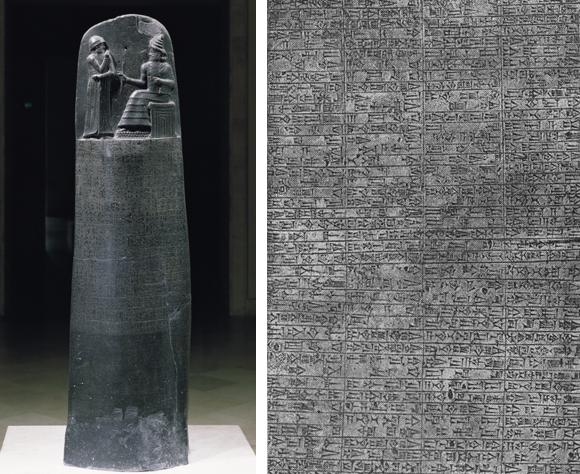
Perhaps the most remarkable and influential creation of its time, Hammurabi’s code is the oldest set of laws known to exist. Hammurabi, king and chief priest of Babylonia from 1792-1750 B.C., expanded his empire greatly before focusing his energies toward wealth and justice for his people. He created a code protecting all classes of Babylonian society, including women and slaves. He sought protection of the weak from the powerful and the poor from the rich. The carving on the stone on which the code is written depicts Hammurabi receiving the divine laws from the sun god, the god most often associated with justice. This stone was unearthed by French archaeologists at S_sa, Iraq (ancient Elam), in 1901-02. The black diorite rock is 2.4 m high and had been broken into three pieces.

Hammurabi’s Code is 44 columns of text, 28 paragraphs of which contain the actual code. There are 282 laws (possibly more have been rubbed off) that probably amend common Babylonian law rather than define it. It describes regulations for legal procedure, fixes rates on services performed in most branches of commerce and describes property rights, personal injury, and penalties for false testimony and accusations. It has no laws regarding religion.

The Code of Hammurabi is significant because its creation allowed men, women, slaves, and all others to read and understand the laws that governed their lives in Babylon. It is unique in that laws of other civilizations were not written down, and thus could be manipulated to suite the rulers that dictated them. The Code is particularly just for its time. Although it follows the practice of "an eye for an eye", it does not allow for vigilante justice, but rather demands a trial by judges. It also glorifies acts of peace and justice done during Hammurabi’s rule. It symbolizes not only the emergence of justice in the minds of men, but also man’s rise above ignorance and barbarism toward the peaceful and just societies still pursued today. In the words of Hammurabi as carved on the stone, "Let any oppressed man who has a cause come into the presence of my statue as king of justice, and have the inscription on my stele read out, and hear my precious words, that my stele may make the case clear to him; may he understand his cause, and may his heart be set at ease!"


-Oracle Thinkquest