August 8, 2013

Honor Spotlight

Pedro Zamora
Cuban-American AIDS educator
Born: February 29, 1972, Diezmero, Cuba
Died: November 11, 1994, Coconut Grove, Miami, FL


Pedro Zamora (February 29, 1972 – November 11, 1994) was a young openly-gay HIV-positive AIDS educator when he was cast as a housemates on the groundbreaking MTV reality show Real World San Francisco. For many young Americans, watching Zamora on camera was their first exposure to a young person living with AIDS. His appearance on the popular show has been credited with increasing AIDS awareness and normalizing those with the disease.

About Pedro Zamora:

Pedro Zamora was born in Havan, Cuba on the leap day of a leap year (February 29, 1972). According to a Wikipedia report, a Santeria priestess deemed Zamora a grande cabeza or "wise one" born to save lives. Zamora came to the U.S. as a Cuban immigrant at the age of 8.

Pedro Zamora and HIV:

Zamora found out he was HIV-positive after giving blood during his junior year of high school. He turned to the Miami-based HIV/AIDS resource center Body Positive for help and support before speaking about his own experience living with the virus. Zamora entered the national spotlight as an AIDS advocate after being featured by Eric Morganthaler on a front page article of the Wall Street Journal. Interviews by Geraldo Rivera, Phil Donahue and Oprah Winfrey followed.
On July 12, 1993, he testified before the United States Congress concerning HIV/AIDS awareness and educational programs. Zamora argued, "If you want to reach me as a young gay man -- especially a young gay man of color -- then you need to give me information in a language and vocabulary I can understand and relate to." Much of Zamora's message still rings true today as gay people of color continue to suffer from rising HIV rates.

More on Pedro Zamora and The Real World:

Pedro Zamora was chosen as a castmember of the MTV reality show, The Real World San Francisco in 1994. He took his new role as an opportunity to teach HIV/AIDS awareness. Zamora educated all of America at the same time he eased the anxieties of his Real World housemates. Zamora began dating partner Sean Sasser while on the show. They exchanged vows in the Real World loft. The show aired a week after the cast moved out of the loft.

Pedro's Last Days:

Pedro's health began to deteriorate during the taping of the show. However, things only got worse after they moved he moved out. Zamora’s T-cell count had dropped to an alarming 32 and he suffered from PML and other serious illnesses. Pedro Zamora died at approximately 4:40am EST on November 11, 1994, the day after the final episode of The Real World San Francisco aired.

Pedro Zamora's Legacy:

Zamora was honored by former President Bill Clinton for his HIV/AIDS awareness work. SW 59th Street in Miami, Florida was given the name "Pedro Zamora Way."


Old News

Earlier this morning, ARTINFO reported that famed choreographer Yvonne Rainer sent a letter to Los Angeles MOCA director Jeffrey Deitch denouncing artist Marina Abramovic’s plans for the museum’s annual gala, which involves installing performers under gala tables, turning them into disembodied rotating heads for three-hour-long stretches over a period of two days. The performers would be paid a paltry $150 for their troubles. Read the full text of the letter below.
November 9, 2011
To Jeffrey Deitch:
I am writing to protest the “entertainment” about to be provided by Marina Abramovic at the upcoming donor gala at the Museum of Contemporary Art. It has come to my attention that a number of young people will be ensconced under the diners’ tables on lazy Susans and also be required to display their nude bodies under fake skeletons.
This description is reminiscent of “Salo,” Pasolini’s controversial film of 1975 that dealt with sadism and sexual abuse of a group of adolescents at the hands of a bunch of post-war fascists. Reluctant as I am to dignify Abramovic by mentioning Pasolini in the same breath, the latter at least had a socially credible justification in the cause of anti-fascism. Abramovic and MOCA have no such credibility, only a flimsy personal rationale about eye contact. Subjecting her performers to public humiliation at the hands of a bunch of frolicking donors is yet another example of the Museum’s callousness and greed and Ms Abramovic’s obliviousness to differences in context and to some of the implications of transposing her own powerful performances to the bodies of others. An exhibition is one thing — this is not a critique of Abramovic’s work in general — but titillation for wealthy diners as a means of raising money is another.
Ms Abramovic is so wedded to her original vision that she – and by extension, the Museum director and curators — doesn’t see the egregious associations for the performers, who, though willing, will be exploited nonetheless. Their desperate voluntarism says something about the generally exploitative conditions of the art world such that people are willing to become victims of a celebrity artist in the hopes of somehow breaking into the show biz themselves. And at sub-minimal wages for the performers, the event verges on economic exploitation and criminality.
This grotesque spectacle promises to be truly embarrassing. We the undersigned wish to express our dismay that an institution that we have supported can stoop to such degrading methods of fund raising. Can other institutions be far behind? Must we re-name MOCA “MODFR” or the Museum of Degenerate Fund Raising?
Sincerely,
Yvonne Rainer
 BlouinArtInfo

August 7, 2013

Art of the Day

Earth’s Skin


El Anatsui (Ghanaian, b. 1944)
2007, Aluminum and copper wire, 177 x 394 in. (449.6 x 1000.8 cm). Courtesy of Guggenheim Abu Dhabi

NYT

August 5, 2013

Literary Pick (***)

Simple Passion
-Annie Ernaux

August 3, 2013

Literary Pick (****)

Ciao! Miami 
-Fawzy Zablah


July 31, 2013

Literary Pick (***)

Middlesex
-by Jeffrey Eugenides

July 30, 2013

RIP

Eileen Brennan, Who Played Flinty Captain in ‘Private Benjamin,’ Dies at 80


Eileen Brennan, a smoky-voiced actress who had worked in show business for more than 20 years before gaining her widest attention as a gleefully tough Army captain in both the film and television versions of “Private Benjamin,” died on Sunday at her home in Burbank, Calif. She was 80. 

Her manager, Kim Vasilakis, confirmed the death on Tuesday, saying the cause was bladder cancer.
Ms. Brennan had had a solid career on the New York stage and in films like “The Last Picture Show” and “The Sting” when she was cast for the film “Private Benjamin,” a 1980 box-office hit starring Goldie Hawn in the title role.
Ms. Brennan played Capt. Doreen Lewis, the slow-burning commanding officer of a pampered, privileged young woman who joins the Army and finds that she isn’t anybody’s little princess anymore. The performance brought Ms. Brennan an Academy Award nomination for best supporting actress. She reprised the role in 1981 in a CBS sitcom based on the film, with Lorna Patterson in the Goldie Hawn role. The TV performance brought Ms. Brennan the Emmy Award for best supporting actress in a comedy, variety or music series. She was nominated for a total of seven Emmys in her career.
But she was forced to leave “Private Benjamin” the following October, when she was hit by a car and critically injured in Venice, Calif. Without her, the series died.
While recovering Ms. Brennan became addicted to pain medication and underwent treatment and later developed breast cancer.
She returned to television in 1985 in a new sitcom, “Off the Rack,” with Edward Asner, but the show lasted only six weeks. Afterward she made guest appearances on other shows. But she never recaptured the attention she had known in the past — as the toast of Off Broadway in “Little Mary Sunshine,” as a film actress in the 1970s, and as an honored comedy star just before her accident.
Verla Eileen Regina Brennan was born on Sept. 3, 1932, and grew up in Los Angeles, the daughter of a newspaper reporter who also worked in sales and a former actress. Later in life, dealing with her own alcohol dependency, she talked about the alcoholism in her family when she was a child.
After attending Georgetown University in Washington, she studied acting at the American Academy of Dramatic Arts in New York, did summer stock and worked as a singing waitress.
Her first big role was the title character in Rick Besoyan’s “Little Mary Sunshine,” a 1959 operetta parody that played at the Orpheum Theater in lower Manhattan. She won an Obie Award for her portrayal of the show’s spunky, fluttery-eyed heroine. A year later she complained to The New York Times that she had been “hopelessly typecast as that kookie girl.”
Perhaps to prove otherwise, she promptly starred in the national tour of “The Miracle Worker,” as Helen Keller’s gravely serious teacher, Annie Sullivan.
Ms. Brennan made her Broadway debut in 1963 playing, to positive reviews, Anna in a City Center revival of “The King and I.” In 1964 she was cast as Irene Molloy, the young widow, in the original Broadway production of “Hello, Dolly!,” with Carol Channing.
Among later stage performances, she appeared in John Ford Noonan’s “A Coupla White Chicks Sitting Around Talking,” a critically praised 1980 two-woman show with Susan Sarandon, and Martin McDonagh’s dark comedy “The Cripple of Inishmaan” (1998), in which she played an alcoholic Irishwoman.
Ms. Brennan made her television debut in “The Star Wagon,” a 1966 PBS special, based on Maxwell Anderson’s play about a man who invented a time machine. Her film debut came a year later, in “Divorce American Style,” a comedy about suburban marriage, starring Debbie Reynolds and Dick Van Dyke.
After a brief stint as an original cast member, along with Ms. Hawn, of “Rowan and Martin’s Laugh-In,” the 1960s sketch-comedy series, she did her first picture for the director Peter Bogdanovich playing a world-weary Texas waitress in “The Last Picture Show” (1971).
Mr. Bogdanovich cast her again in “Daisy Miller” (1974), as a society hostess, and in “At Long Last Love” (1975), as a singing maid.
Ms. Brennan played a madam with a heart of gold in the Oscar-winning 1973 film “The Sting” and appeared in two comedy-noir films written by Neil Simon, “Murder by Death” (1976) and “The Cheap Detective” (1978).
In later years, she appeared in “Miss Congeniality 2: Armed and Fabulous” (2005), as William Shatner’s mother (despite being a year younger than Mr. Shatner). But she was most visible on television, doing guest appearances on a variety of series.
In addition to her Emmy, she received six Emmy nominations. Two were for “Private Benjamin.” The others were for her work in “Taxi,” “Newhart,” “Thirtysomething” and “Will & Grace,” in which she had a recurring role as Sean Hayes’s formidable acting teacher.
Throughout her career she talked openly about addiction. “It’s so horrible and it can be so disastrous, yet there’s something about the sensitivity of the human being that has to face it,” she said in a 1996 interview. “We’re very sensitive people with a lot of introspection, and you get saved or you don’t get saved.”
Ms. Brennan was married from 1968 to 1974 to David John Lampson, an aspiring actor at the time. They had two sons, Patrick and Sam, who survive her, along with a sister, Kathleen Howard, and two grandchildren.

 -NYT

July 26, 2013

News

Royal Baby: Duchess of Cambridge Gives Birth to a Son 


LONDON—Britain's likely future king—and a certified instant celebrity—arrived here on Monday when the Duchess of Cambridge, better known as the former Kate Middleton, gave birth to a boy.
The birth culminates a royal-baby frenzy that began with the announcement of the pregnancy last year by the Duchess and her husband, Prince William, both 31 years old and the standard-bearers for a younger generation of British royals.
The new arrival immediately changes the line of succession to the British throne, which has been occupied by the new arrival's 87-year-old great-grandmother, Queen Elizabeth II, for six decades.
As the first child of the Duke and Duchess of Cambridge the new royal begins life third in line to the throne—behind only Prince William, who is second in line, and his father, Prince Charles, who is first. 
The pregnancy has drawn massive global interest focused on everything from the size of the duchess's baby bump—meticulously chronicled by Britain's paparazzi—to the mother-to-be's fashion choices.
The fevered anticipation intensified as the birth neared; in recent days, media crews camped outside the London hospital where the baby was expected to be delivered.
The most intense speculation focused on the baby's sex—which the parents chose not to learn—and possible names, on which betting parlors have been taking wagers.
The favorite on Monday evening was at betting parlor Paddy Power PLS.DB -1.99% PLC was Alexandra, at 11-to-4, followed by George at 6-to1.
Some questions were answered on Monday, when the royal family announced the couple had greeted an 8 lb., 6 oz. boy. No name was announced, but the new arrival will be formally known as His Royal Highness the Prince of Cambridge.
The Duchess chose to have her baby at central London's St. Mary's Hospital, where Princess Diana gave birth to Prince William and his brother, Prince Harry.
She had arrived there, in the early stages of labor, shortly before 6 a.m. on Monday.
The hubbub around the royal baby turned St. Mary's into London's newest tourist attraction, as sightseers joined the multiplying media pack on what weather forecasters said was the hottest day of the year in London.
"We are here in London for fun, visiting friends, going to a wedding and we were training it out of Paddington this morning, which is just around the corner, said Allison Witt, a tourist from Texas. "So we thought we'd get a few pictures and witness it firsthand."
Some of the gawkers have been at the site for days, camped out alongside the reporters.
Maria Scott, who has been staying in a tent near the hospital with her 13-year-old daughter since Saturday, said the atmosphere Monday morning was "electric" when word arrived that the Duchess was in labor.
Security at the hospital increased in recent days as the media pack grew. Hospital officials on Monday beseeched the throng to keep a pathway clear for nonroyal patients to enter the hospital, and some workers grumbled about the difficulty of getting to their jobs.
In the past, the line of succession would have been different for a royal baby girl. Previously, any daughter born to the couple wouldn't have enjoyed an equal right to inherit the British throne. The crown would have passed to the eldest son, only going to a daughter if there were no boys.
But under a new law, which applies to any baby born after October 2011, the first-born child is the heir apparent regardless of gender.
The huge attention focused on the photogenic Duke and Duchess and their new child reflects a transition to a younger generation of Britain's royal family. Still, it will likely be quite a while before the new addition to the family takes up the crown.
Sixty-four-year-old Prince Charles has waited decades for a chance to be king, parked in line behind his mother and her historic 61-year reign, which has weathered sweeping social transformation in the U.K., big swings in the family's popularity and the end of Britain's global empire.
Unlike in the Netherlands, where 75-year-old Queen Beatrix recently abdicated in favor of her son, there has been no suggestion that the British monarch will step down.
But the Queen has recently begun scaling back her vigorous public duties and limiting her long-haul travel, which leaves a potentially greater role for her son and grandchildren.
The royal family is currently enjoying a high degree of public support, boosted by the feel-good factor of the Duke and Duchess's wedding in 2011 and the arrival of their first child.
The Queen had a 90% approval rating around the time of her Diamond Jubilee celebrations in June 2012, according to a survey by pollsters Ipsos Mori. That marked the highest levels of satisfaction with the monarch since 1992, when Ipsos Mori started asking the question.
The Jubilee reminded people that the Queen has dedicated her life to public service, said Vernon Bogdanor, a leading expert on the British constitution and a research professor at Kings College London.
"Not that she hasn't put a foot wrong,…but she reflects what [British] people would like to be: good humored, good natured, doing what she has to do without complaint." 

The public hasn't always been so positive about the royal family.
The House of Windsor's brand suffered damage in the late 1990s following the bitter divorce of Prince Charles and Diana Spencer and the subsequent car crash that killed the Princess of Wales. The couple's public bickering had revealed the royal family's inner turmoil.
And, the Queen's seemingly chilly initial response to Diana's death, along with the scandal-ridden divorce of another son, Prince Andrew, from Sarah Ferguson, compounded the problems.
But royals have managed to largely recover, thanks to a carefully crafted public-relations plan, some judicious trims to its spending and the help of the popular Duke and Duchess, who has been frequently photographed throughout her pregnancy sporting an array of elegant outfits spanning high-street retailers and designer outlets.
But the family continues to find itself embroiled in scandal from time to time. And, it still finds itself the subject of seedier tabloid interest, from Prince Harry's naked romp in Las Vegas to the publication of topless photos of the duchess. 
One area that continues to rankle the public is cost. Amid national austerity, the royals must balance the demands for frugality from the British taxpayer while also maintaining the pomp and ceremony expected of a 300-year old dynasty, which also serves as a tourism attraction for the U.K. The royal household's income comes mainly from a government grant, which was £33.3 million ($50.8 million) for 2012-13.
The new prince is expected to be christened; as future king, he would be the head of the Church of England.
There is a long tradition of using the royal christening gown, the Lily Font—which is a 19th century silver vessel—and consecrated water from the Jordan River. While royal christening venues can vary, Prince William was christened in the Music Room at Buckingham Palace by the Archbishop of Canterbury.

WSJ

July 21, 2013

Art of the Day

Kiki de Montparnasse  
-by Pablo Gargallo (1881-1934) 


July 19, 2013

Honor Spotlight

Kathrine Switzer


In 1967, five years before women were officially allowed to compete,
Kathrine Switzerwas the first woman to enter and complete the Boston
Marathon as a numbered entry.  She registered under the gender-neutral
name of “K.V. Switzer”.

After realizing that a woman was running, race organizer Jock Semple went after Switzer shouting, “Get the hell out of my race and give me those numbers.” however, Switzer’s boyfriend and other male runners provided a protective shield during the entire Marathon.
These photographs taken of the incident made world headlines, and in
1974 Kathrine later went on to win the NYC marathon with a time of
3:07:29.


-Republic Of You

July 15, 2013

Art of the Day

Rembrandt van Rijn - Self-Portrait (1659) detail


Born: July 15, 1606
Died: October 4, 1669

June 20, 2013

Quote of the Day

June 19, 2013

Photograph


Joanne Woodward baking sweet rolls, Paul Newman making eggs, Anthony Perkins dancing.

Literary Pick (****)

Yellow Star
-Jennifer Roy

June 14, 2013

Quote of the Day

“The longer and more carefully we look at a funny story, the sadder it becomes.”
Nikolai Gogol

Literary Pick (****)

Ellen Foster
-Kaye Gibbons

June 10, 2013

Literary Pick (***)

This is how you lose her
-Junot Diaz

June 5, 2013

foto


Edith Piaf and her lover Douglas Davis

June 4, 2013

Poetry

“Extinguish my eyes, I'll go on seeing you.
Seal my ears, I'll go on hearing you.
And without feet I can make my way to you,
without a mouth I can swear your name.

Break off my arms, I'll take hold of you
with my heart as with a hand.
Stop my heart, and my brain will start to beat.
And if you consume my brain with fire,
I'll feel you burn in every drop of my blood.”
Rainer Maria Rilke

June 3, 2013

Literary Pick (****)

Endless Love 
-Scott Spencer


My favorite novel of all time, alongside Lolita.

May 24, 2013

Literary Pick (*)

Mein Kampf
by Adolf Hitler 


My one star review has nothing to do with the fact that this book was written by Hitler. My review is purely based on the fact that it took me 7 months to finish reading it. Not because it was a difficult read, but because, as cliche as it sounds, it was tediously boring and uninteresting.

The one thing that kept going through my mind as I spent months reading it was how embarrassing it was. Hitler comes off as painfully ignorant, and not the kind of ignorant you call someone when you want to dismiss their ideas because you can't come up with a proper opposing argument, but the kind ignorance that sheltered people possess, very much like the kind of ignorance and narrow-mindedness evangelicals and hard-core Christians exhibit.
I read this book out of pure curiosity, just to see what kind of things he wrote, and perhaps for some insight on his personal life, which by the way doesn't tell you much. The entire book is political rubbish. I read somewhere that he later expressed regret on writing Mein Kampf, but am unable to find the reason why. I wonder if it's because he later realized how crudely obscene and vulgar he portrayed himself.

This book has made me carefully choose the books I read from now on. I don't ever want to go through what I went through with this book ever again.

May 11, 2013

Quote of the Day

“Holding onto anger is like drinking poison and expecting the other person to die.” ~ Buddha

April 29, 2013

Art of the Day

Sollie 17
Edward Kienholz 


"Kienholz' work during the 1970s and 1980s became more sophisticated and elaborate. In a later example entitled Sollie 17 (1979-1980) Kienholz placed three cast images of the same man within a realistically constructed dilapidated urban dwelling. Clad only in a pair of baggy undershorts, the old man is seen lying on a soiled bed reading a pulp Western. On the right edge of the bed the same man sits. His head - a framed photograph attached to the cast body - is downcast as the lonely man plays a game of cards. Finally the man is seen to the rear gazing out a window which opens onto an urban cityscape. The barrenness of the man's life is echoed in the bare bulb that illuminates this sordid interior from above. This is a powerful image of alienation and the despair of a vacuous life; a life wherein time is not measured by a clock but by the water that drips from a faulty tap. Kienholz reproduced familiar environments by taking discarded objects from everyday life and assembling them in such a way that they took on a renewed significance. With an uncanny eye for detail and arrangement Kienholz orchestrated frozen dramas. By demanding that the viewers take an active part in his play he confronts them with images of themselves and the world around them. Everything suddenly becomes imbued with an allegorical significance and a once familiar world becomes hostile. Kienholz acknowledged that his wife often assisted him in his work. After 1973 Kienholz spent six months of each year in Berlin and the other six months in Hope, Idaho. Kienholz died of a heart attack on June 10, 1994 in Hope, Idaho. His burial was reminiscent of his "tableaux." He was buried in the passenger seat of a 1940 Packard coupe with the ashes of his dog in the back seat and, in the glovebox, a bottle of vintage wine. In 1996, a retrospective of his work was shown at the Whitney Museum of American Art in New York."
-Answers

April 24, 2013

Quote of the Day

"I realized that I should have had only 30 women in the show." 

- Peggy Guggenheim, after her husband Max Ernst left her for Dorothea Tanning, one of the thirty-one artists represented at Art of This Century's Exhibition by 31 Women

April 22, 2013

Artist of the Day

Diane Arbus


Three decades after Diane Arbus took her own life, her controversial portraits of the eccentric, the freakish and the alienated continue to exert a powerful influence on modern photography. "Photography was a license to go wherever I wanted to go and do whatever I wanted to do," Arbus said. With a camera as a shield, she entered a world far beyond the affluent New York of her youth, and returned with unforgettable images-the exasperated child with a toy hand grenade, an unsettling pair of twins, a Jewish giant towering over his parents-that have become icons of strangeness and pathos.

 Born in New York City on March 14, 1923, the eldest daughter of David Nemerov and Gertrude Russek, Diane was raised in a household of unusual privilege. Her mother's family owned the Russeks chain of fur and department stores, where her father worked as merchandising director. The son of a grocer, David Nemerov had worked his way up from the position of a window dresser to marry the founder's daughter. Diane, her elder brother Howard and her younger sister Renée were all born into a noveau riche family of the New York fashion circle, where the image of prosperity counted even more than wealth itself. 

Of her childhood, Diane would later say: "I was treated like a crummy princess." A private, intelligent girl, highly devoted to her brother, Diane was nevertheless expected to conform to an affluent Jewish ideal that included expensive clothes, piano lessons and the prospect of becoming a full-time wife and mother. This sheltered upbringing, in which she was shielded from all signs of poverty or strangeness, would one day drive her to seek out images of darkness and transgression against societal norms in her work as a photographer. 

Even as a child, Diane rebelled against her family in small ways. Though her father objected to the artistic ambitions of his children, Diane excelled in painting at Fieldston, a private school in the Riverdale neighborhood of the Bronx, and confessed that she wanted to be a "great sad artist" when she grew up. (Eventually, the Nemerov children all became artists, notably Howard, who won a Pulitzer Prize for poetry and served as Poet Laureate of the United States from 1988-1990.) In 1937, when Diane was 14, an even greater rebellion presented itself: she fell in love with Allan Arbus, a copy boy in the Russeks art department-and insisted that she wanted to marry him right away. 

Despite the fact that their own marriage had also crossed social boundaries, Diane's parents strongly opposed her romance with this 19 year old whose only ambition was to become an actor. Nonetheless, she and Allan continued a clandestine courtship for the next four years. While her brother went off to Harvard University, Diane insisted that marriage was all she wanted. Finally, her parents relented, and she and Allan were married on April 10, 1941, shortly after Diane's eighteenth birthday. 

During World War II, Allan was trained in combat photography. After his return, he and Diane began to support themselves as fashion photographers. Diane learned the trade secondhand, assisting Allan at photo shoots and taking lessons from him in the darkroom. Their first major account was photographing Russeks fashion and furs for newspaper ads; other clients soon followed, and by 1947 they were shooting fashion speads for Glamour, Vogue and other magazines on a regular basis. 

As a fashion duo, the couple had an almost symbiotic relationship, working in close collaboration on all their assignments. Despite their apparent success, however, they often struggled: fashion work did not pay very well, and Diane's family refused to help support the young couple. Diane herself sometimes suffered from intense depression, which rarely had a visible cause, and may have been genetic in nature. In any case, she insisted that she wanted nothing more than to be a faithful wife and a loving mother to their two daughters, Doon and Amy. 

 Moreover, neither Diane nor Allan found fashion photography-with its sameness and lack of artistic freedom-very satisfying. Allan continued to dream of success as an actor, while Diane began to take pictures on her own. Chronically shy at first, she began by photographing children and her friends; in 1957, however, she withdrew from fashion work to pursue her own projects full-time. She admired photographer Lisette Model, who was famous for her pictures of poverty and the grotesque; after repeatedly calling Model in hopes of purchasing one of her photographs, she was invited to join Model's art class. 

During this period, the elements of Diane's characteristic style began to emerge. Like Model, Diane felt that photography was an exchange between artist and subject, and that it often took many exposures to bring out the subject's true character. Diane was drawn to the strange, even the taboo. "I want to photograph what is evil," she told Model, and with her 35-mm camera as a shield, she ventured into unusual places (tenements, Coney Island, circuses, Hubert's Freak Museum), snapping hundreds of pictures. 

Soon afterward, the Arbuses' marriage crumbled. There was apparently infidelity on both sides. Years earlier, Diane had engaged a brief affair with Alex Eliot, the art editor of Time and a longtime mutual friend of the Arbuses; later, Allan fell in love with a woman in one of his acting classes. In 1959, they decided to separate, though they did not divorce for another decade, and Allan continued to send money to Diane and their children when he could. (As an actor, Allan eventually found success, notably in a featured role on the television series M*A*S*H.) 

Though deeply depressed by the separation, Diane continued to work, contributing photo essays to Esquire magazine. She photographed people on the street as well as such unconventional subjects as dwarves, giants and transvestites, taking many exposures until she captured the strangeness in the ordinary and the humanity of the strange. Most of her pictures were composed like conventional portraits, with the subject looking directly into the camera lens; the Rolleiflex camera she used provided great clarity and vividness within its square frame. 

To obtain the emotional immediacy that made her pictures so famous, Diane Arbus often went to extremes, sometimes following her subjects into their homes. Rumor has it that Arbus slept with many of her subjects; in any case, she became much more sexually adventurous after her separation. "Taking a portrait is like seducing someone," she told a friend, and she seems to have approached sex much as she did photography: as a way of testing herself, of having novel experiences and fighting off depression. 

By the early 1960s, Arbus's uncanny magazine work had become highly regarded in the intimate circle of New York artists and publishers. As her reputation grew, she began to receive fashion and celebrity assignments from such publications as Show and Harper's Bazaar, where her friend Marvin Israel worked as art director. Her subjects included Mae West, Marcello Mastroianni and Norman Mailer-who commented that "Giving a camera to Diane Arbus is like giving a hand grenade to a baby." She also began experimenting with a direct flash, which seemed to peel away the public faces of her subjects. This use of the flash, along with the square frame, became one of the most widely imitated features of her work. 

Three Arbus pictures were included in a 1965 exhibit at the Museum of Modern Art, "Recent Acquisitions." Reaction to Arbus's portraits of nudists and female impersonators was sharply divided; workers at the museum had to come in early to wipe the spit off her photographs. Similar controversy greeted the 1967 show "New Documents," in which her disturbing portraits were given a room of their own. That show is now seen as a landmark in this history of photography, but at the time, Arbus was wary of being stereotyped as a photographer of "freaks." 

With her younger daughter away at school, Arbus moved into an artists' colony in New York, where she taught a class in photography. In her lessons, she emphasized that a picture was the product of the relationship between artist and subject: a photographer's truest art lay in coaxing a moment of revelation from a sometimes-reluctant individual. At the same time, however, Arbus had begun to take pictures of mentally retarded patients at a home in Vineland, New Jersey-subjects who were completely absorbed in themselves, whom she could never control or reach. This frustration contributed to the depression and loneliness that had long been part of Arbus's life. 

On July 26, 1971, Diane Arbus committed suicide by slashing her wrists. Her friend Marvin Israel found her two days later, lying fully clothed in her bathtub. A rumor arose that Arbus had taken pictures of herself as she lay dying, but no film was ever recovered. Because Arbus left no note or other message, the reason for her suicide remains uncertain. Her reputation has only increased since her death, due largely to a famous retrospective at the Museum of Modern Art and the publication of several collections of her photographs, edited by Marvin Israel and her daughter Doon. 


 Brain-Juice

April 19, 2013

Art of the Day


Date
13th Century
Medium
Bronze
Dimensions
object: 40 3/4 x 15 3/4 x 14 1/4 in. (103.5 x 40.0 x 36.2 cm)
Department
Asian Art
Classification
Sculpture
Credit
Founders Society Purchase, Sarah Bacon Hill Fund
-Detroit Institute of Art

Photograph


Josef Albers's collage of photos of Gropius with Shifra Carnesi, taken in Ascona, 1930.

April 16, 2013

Quote of the Day

“First they ignore you, then they ridicule you, then they fight you, and then you win.”
Mahatma Gandhi

April 8, 2013

RIP


Former British Prime Minister Margaret Thatcher, one of the most formidable leaders of the 20th century, died Monday morning from a stroke, reports The Telegraph. She was 87.

"It is with great sadness that Mark and Carol Thatcher announced that their mother Baroness Thatcher died peacefully following a stroke this morning. A further statement will be made later," confirmed Thatcher's spokesman.

As the first female British prime minister and a member of the Conservative Party, Thatcher was a polarizing figure in British politics, serving from 1979-1990. On one hand, she was lauded for her bold condemnation against Communism—it was the Soviets themselves who coined her "The Iron Lady"; on the other hand, her approach to the economy by privatizing aspects of Britain’s government and for reducing social services and restricting labor unions unleashed a fury of accusations that she was destroying the country's safety net.

One of the key turning points in Thatcher's political career was when she helped Britain achieve victory over Argentina in the Falklands War in 1982. Although sovereignty of the islands was not settled, her popularity soared, helping assure her re-election in 1983.

As one of only a handful of female world leaders, Thatcher cultivated close relationships with politicians, including U.S. President Ronald Reagan; the two are considered pivotal "architects of the West’s victory in the Cold War." Thatcher also became a fan of Soviet leader Mikhail Gorbachev and his policies of “perestroika,” which was a movement to reform Communism.

Thatcher left office in November 1990 after serving three terms as prime minister. She was given the title “Baroness,” and she was welcomed into the highest order of knighthood in England, the order of the garter. She also established the Margaret Thatcher Foundation, an organization dedicated to encouraging free trade, free enterprise, and democracy throughout the world.

Thatcher's health started to suffer through a series of strokes starting in 2001, and in 2008, her daughter Carol announced she had been diagnosed with dementia.

Thatcher is survived by her son and daughter. Her husband of almost 52 years, Sir Dennis, died in 2003.

April 3, 2013

Art of the Day

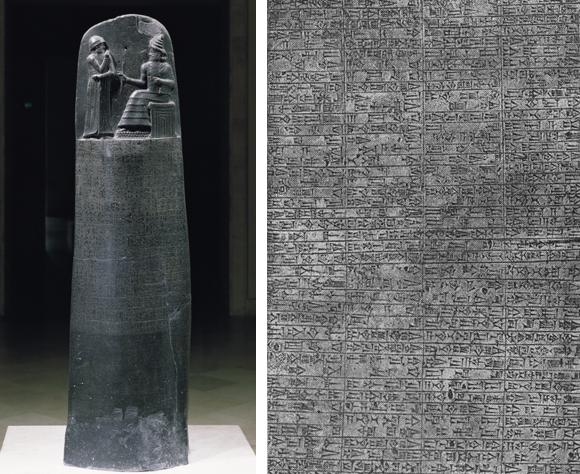
The Code of Hammurabi


Perhaps the most remarkable and influential creation of its time, Hammurabi’s code is the oldest set of laws known to exist. Hammurabi, king and chief priest of Babylonia from 1792-1750 B.C., expanded his empire greatly before focusing his energies toward wealth and justice for his people. He created a code protecting all classes of Babylonian society, including women and slaves. He sought protection of the weak from the powerful and the poor from the rich. The carving on the stone on which the code is written depicts Hammurabi receiving the divine laws from the sun god, the god most often associated with justice. This stone was unearthed by French archaeologists at S_sa, Iraq (ancient Elam), in 1901-02. The black diorite rock is 2.4 m high and had been broken into three pieces.

Hammurabi’s Code is 44 columns of text, 28 paragraphs of which contain the actual code. There are 282 laws (possibly more have been rubbed off) that probably amend common Babylonian law rather than define it. It describes regulations for legal procedure, fixes rates on services performed in most branches of commerce and describes property rights, personal injury, and penalties for false testimony and accusations. It has no laws regarding religion.

The Code of Hammurabi is significant because its creation allowed men, women, slaves, and all others to read and understand the laws that governed their lives in Babylon. It is unique in that laws of other civilizations were not written down, and thus could be manipulated to suite the rulers that dictated them. The Code is particularly just for its time. Although it follows the practice of "an eye for an eye", it does not allow for vigilante justice, but rather demands a trial by judges. It also glorifies acts of peace and justice done during Hammurabi’s rule. It symbolizes not only the emergence of justice in the minds of men, but also man’s rise above ignorance and barbarism toward the peaceful and just societies still pursued today. In the words of Hammurabi as carved on the stone, "Let any oppressed man who has a cause come into the presence of my statue as king of justice, and have the inscription on my stele read out, and hear my precious words, that my stele may make the case clear to him; may he understand his cause, and may his heart be set at ease!"


-Oracle Thinkquest

April 2, 2013

Poetry

Demain, dès l'aube

Demain, dès l'aube, à l'heure où blanchit la campagne,
Je partirai. Vois-tu, je sais que tu m'attends.
J'irai par la forêt, j'irai par la montagne.
Je ne puis demeurer loin de toi plus longtemps.

Je marcherai les yeux fixés sur mes pensées,
Sans rien voir au dehors, sans entendre aucun bruit,
Seul, inconnu, le dos courbé, les mains croisées,
Triste, et le jour pour moi sera comme la nuit.

Je ne regarderai ni l'or du soir qui tombe,
Ni les voiles au loin descendant vers Harfleur,
Et quand j'arriverai, je mettrai sur ta tombe
Un bouquet de houx vert et de bruyère en fleur.


Tomorrow at Dawn

Tomorrow, at dawn, at the hour when the countryside is alit,
I will leave. See here, you know what I must do.
I will go through the forest, I will go across the mountain.
I will not remain far from you for long.

I will trudge on with eyes fixed on my thoughts,
Without seeing what it outside of me, without hearing any noise,
Alone, unknown, bent, with crossed hands,
Sad, and the day will be for me as night.

I will not notice either the golden sunset as night falls,
Nor the distant mist which descends over Harfleur,
And when I arrive, I will place on your grave
A bouquet of holly and heather in bloom.

by Victor Hugo dedicated to his young daughter Léopoldine Hugo after her death.

http://upload.wikimedia.org/wikipedia/commons/a/ac/Auguste_de_Chatillon_-_L%C3%A9opoldine_Hugo.jpg 


Art of the Day

Spring Landscape in Rain

Bai Xueshi
born 1915 China

March 25, 2013

Photograph

 Hermann Hesse with "Narciss"

March 23, 2013

R.I.P

Bebo Valdés, Giant Of Cuban Music has passed away

One of the giants of Cuban music, pianist and composer/arranger Bebo Valdés, died Friday in Switzerland due to complications from pneumonia, according to his wife and manager. He was 94.Ramón Emilio "Bebo" Valdés Amaro was born in 1918 in a village outside Havana. Trained at conservatory, and having absorbed the sounds of Afro-Cuban street music and American jazz in various ensembles, he became the house pianist and arranger at the Tropicana Nightclub in 1948. The Tropicana was the hottest venue in Havana at the time; many American entertainers performed there, and Valdés became known as the go-to arranger in town for studio dates, film scores and dance numbers. In 1952, he also participated in the first Afro-Cuban descarga, or jam session, recorded in Cuba, where a group improvisation turned into the recording "Con Poco Coco."

But as his career was booming, a revolutionary government took over in Cuba, accompanied by a crackdown on the entertainment industry. In 1960, he left Cuba to play a gig in Mexico City with his own band. He never returned, leaving behind his wife and children. Valdés eventually wound up in Sweden, where he remarried and pursued a quieter music career, often playing piano for cruise ships or in choice hotels.
"If you are a musician and you do one thing, you should enjoy what you do," Valdés told NPR's Felix Contreras in 2006. "This is my profession, and it is my hobby, and I live in love with what I do. In those years in Stockholm, even if I wasn't successful, I did it because I liked it, and I'll keep doing it until I die."
Meanwhile, one of his children had matured into a piano virtuoso himself, and had co-founded his own jazz-influenced, genre-crossing band called Irakere. When Chucho Valdes and Irakere played a date at Carnegie Hall in 1977, Bebo Valdes crossed the Atlantic Ocean to reunite with his son. It set into motion a reconciliation which resulted in several collaborations, in concert and on recordings like the Latin jazz performance film Calle 54 and the duet album Juntos Para Siempre.
Late in his career, Bebo Valdés enjoyed a resurgence of popularity. In 1994, another Irakere veteran and Cuban exile, reedman Paquito D'Rivera, convinced Valdés to record Bebo Rides Again, a disc of Cuban classics mixed with original compositions. The album led to future recordings, among them Grammy-winning efforts like El Arte de Sabor and Lagrimas Negras. He was also the inspiration and pianist for the animated film Chico and Rita, about Cuban musicians in the 1940s.
"This attention is a gift from God," he told NPR. "I did not ask for all of this. But since it was sent to me, I accept it from the heart."

~NPR

Art of the Day


Finial in the Form of a Parrot
Object Name: Finial
 
Date: 17th–18th century
 
Geography: Northern India
 
Medium: Brass
 
Dimensions: H. 5 3/4 in. (14.6 cm) L. 11 in. (27.9 cm)
 
Classification: Metal
 
Credit Line: Gift of Robert W. and Lockwood De Forest, 1919
 
Accession Number: 19.135.3

R.I.P

Chinua Achebe, Nigerian Author Of 'Things Fall Apart,' Dies


Nigerian novelist Chinua Achebe, widely seen as the grandfather of modern African literature, has died at the age of 82.
From the publication of his first novel, "Things Fall Apart", over 50 years ago, Achebe shaped an understanding of Africa from an African perspective more than any other author.
As a novelist, poet, broadcaster and lecturer, Achebe was a yardstick against which generations of African writers have been judged. For children across Africa, his books have for decades been an eye-opening introduction to the power of literature.
Describing Achebe as a "colossus of African writing", South African President Jacob Zuma expressed sadness at his death.
Nelson Mandela, who read Achebe's work in jail, has called him a writer "in whose company the prison walls fell down."
Achebe's "Things Fall Apart", published in 1958, told of his Igbo ethnic group's fatal brush with British colonizers in the 1800s - the first time the story of European colonialism had been told from an African viewpoint to an international audience. The book was translated into 50 languages and has sold more than 10 million copies worldwide.
He later turned his sights on the devastation wrought to Nigeria and Africa by military coups and entrenched dictatorship.
“"Anthills of the Savannah," published in 1987, is set after a coup in a fictional African country, where power has corrupted and state brutality silenced all but the most courageous.
The pain at Achebe's death was felt across Nigeria, and particularly in the southeastern homeland of the Igbos.
"Our whole household is crying out in grief," a cousin and traditional chief, Uba Onubon, told Reuters in Ikenga village.
WAR
Born at Ogidi in southeast Nigeria on November 16, 1930, Achebe was the son of a Christian evangelist. He went to mission schools and to University College, Ibadan, and taught briefly before joining the Nigerian Broadcasting Corporation, where he was director of external broadcasting from 1961 to 1966.
When his homeland broke away from Nigeria in a disastrous bid for independence, Achebe launched a publishing company in Enugu, capital of the self-declared republic of Biafra.
After the war, which cost a million lives along with Biafra's hopes of statehood, Achebe returned to Enugu to teach at the nearby Nsukka University.
In 1972 he moved to Massachusetts and since then spent much of his time in the United States, with occasional spells in Nigeria. His last post was at Brown University in Rhode Island.
Through tears, former government minister and friend Dora Akunyili said Achebe's death "leaves a void in Nigeria, Africa and globally."
Although Achebe never won the Nobel literature prize like fellow Nigerian Wole Soyinka his works won praise for their vivid portrayal of African realities and their accessibility.
His contribution was recognized when he won The Man Booker International Prize in 2007.
"Professor Achebe will live forever in the hearts and minds of present and future generations through his great works," Nigerian President Goodluck Jonathan said in a statement.
CORRUPTION
Achebe never hesitated to turn harsh words on his home country, publishing a pamphlet in 1983, "“The Trouble With Nigeria", excoriating its corruption and condemning it as "dirty, callous, noisy, ostentatious, dishonest and vulgar. In short it is among the most unpleasant places on earth."
"The Nigerian problem is the unwillingness or inability of its leaders to rise to the responsibility," he wrote, words which chimed with the feelings of many Nigerians.
In 2004, he turned down the title 'Commander of the Federal Republic' offered to him by then President Olusegun Obasanjo, replying that he was appalled by the cliques who had turned Nigeria into "a bankrupt and lawless fiefdom".
Undaunted, President Jonathan also tried to confer a national honor on him in 2011. He snubbed that one too.
A car accident put Achebe in a wheelchair in 1990 and he wrote no books for more than 20 years.
His last, "There Was a Country" was a deeply personal account, in prose and poetry, of the horrors of the 1967-70 Biafra war, lifting decades of silence on the loss of friends, family and countrymen that forever shaped his life.


March 22, 2013

Quote of the Day


“You may shoot me with your words, you may cut me with your eyes, you may kill me with your hatefulness, but still, like air, I'll rise!”
Maya Angelou

Photograph of the Day


Simone de Beauvoir, Jean Paul Sartre and Ernesto ‘Che’ Guevara (Cuba, 1960)

March 21, 2013

Literary Pick (**)

Pale Fire
-Vladimir Nabokov


March 16, 2013

Art news

Yoko Ono awarded the 2012 Oscar Kokoschka prize, Austria’s highest award for applied contemporary art. 

On Thursday 1 March 2012, artist Yoko Ono won the 2012 Oscar Kokoschka prize, Austria’s highest award for applied contemporary art.

The Oskar Kokoschka prize, named after an Austrian painter who died in 1980, is awarded every two years to a contemporary artist and is worth 20,000 euros (26,600 dollars).
By awarding Yoko Ono the Oskar Kokoschka Prize 2012, the jury acknowledges her distinguished artistic career as a whole and her clear sociopolitical positioning, explains jury chairman Gerald Bast.
The Tokyo-born artist ranks amongst the most important representatives of the Fluxus movement and was a pioneering figure in the avant-garde New York art scene as a filmmaker, composer of experimental music, and vocalist.
In 1962, Yoko returned to Japan for two years, where she drew attention with her numerous solo exhibitions and performances. From 1964-1966, and 1972 onwards, she lived in New York once again.
“Wall Piece for Orchestra” or “Cut Piece” are two of her most exciting and memorable concept art projects.
In 1972 and 1987, she participated in the documenta in Kassel.
In 2008, the Kunsthalle Bielefeld organised a retrospective exhibition on her work.
At the Venice Biennale 2009, she was awarded the Golden Lion, the highest recognition for a living artist.
Time and again, she causes a furore with large-scale actions for the benefit of world peace and compliance with international human rights. Her commitment to the recognition of same-sex partnerships, her political statements, and her artistic work make the music and concept artist an extraordinary personality – and not only in the art scene.
Yoko Ono lives and works in New York.
The artist was selected for the Oskar Kokoschka Prize 2012 by a jury consisting of Dr. Gerald Bast (chairman, rector of the University of Applied Arts Vienna), Univ.-Prof. Brigitte Kowanz (representative of the Senate of the University of Applied Arts Vienna), General Secretary Mag. Friedrich Faulhammer (represented by MinR Dr. Peter Seitz, representative of the BM:UKK – Austrian Federal Ministry for Education, Arts and Culture), Mag. Olga Okunev (representative of the BM:UKK), em.o.Univ.-Prof. Arch. Mag.arch. Hans Hollein (president of the Austrian Arts Senate, indisposed on short notice due to illness), Karola Kraus (director of the Museum Moderner Kunst Stiftung Ludwig), Prof. Dr. Erwin Melchardt (representative for media coverage on art), Mag. Eva Blimlinger (rector of the Academy of Fine Arts Vienna), Dr. Klaus Albrecht Schröder (director of the Albertina, represented by Dr. Antonia Hoerschelmann), and Univ.-Prof. Dr. Daniela Hammer-Tugendhat (University of Applied Arts Vienna, head of the Art History department).
With this decision, the jury honours Yoko Ono as “an exceptional artistic personality who is not only one of the most important members of the Fluxus movement but also of the utmost topicality given, in particular, her transdisciplinary approach in artistic production. Her multimedia artistic work, which is connected by an ideology-critical red thread, ranges from film to experimental music, concept art to performance. In her work, Yoko Ono links the pursuit of artistic innovation with the assertion of art’s efficacy in society, which is convincingly evidenced in her political engagement for peace and human rights.”
The prize – established by the Austrian Federal Government in 1980 on the occasion of the death of the painter Oskar Kokoschka, born 1886 in Pöchlarn – is awarded to a visual artist every two years in recognition of his or her artistic work. The Oskar Kokoschka Prize is one of the most important awards for visual art in Austria, bestowed to a national or also international artist. The first prize was given to Hans Hartung in 1981; since then Mario Merz, Gerhard Richter, Siegfried Anzinger, Agnes Martin, Jannis Kounellis, John Baldessari, Maria Lassnig, VALIE EXPORT, Ilya Kabakov, Günter Brus, Martha Rosler, William Kentridge, and Raymond Pettibon, in 2010, have received this distinction.
The presentation of the Oskar Kokoschka Prize by the Federal Minister of Science and Research and organised by the University of applied Arts Vienna took place – in accordance with the statutes – on March 1, the birthday of Oskar Kokoschka.


March 4, 2013

Quote of the Day

“When the people fear the government there is tyranny, when the government fears the people there is liberty.”